Stroke Etiology Testing: 6 Critical Tests That Reveal What Caused Your Stroke
A stroke diagnostic test is the most important step in surviving a stroke and preventing another one. When someone comes to the hospital with sudden weakness, slurred speech, or vision loss, the first question a neurologist has to answer is not just “Did this person have a stroke?” — it’s “Why did it happen, and can it happen again?” It’s that second question where stroke diagnostic tests come into play, and at Consultant Corner we walk every patient through the process, whether they’re receiving treatment in Bloomington, Illinois or El Paso, Texas.
This guide explains in detail what exactly stroke diagnostic tests involve, why each test is important, what the results mean for your treatment plan, and when you should schedule an evaluation with a neurologist.
What is a stroke diagnostic test?
Stroke diagnostics refers to the neurological tests and imaging studies used to determine the underlying cause of a stroke. “Etiology” means cause — so a stroke diagnostic is a medical investigation that identifies exactly what caused the interruption of blood flow to the brain.
Not all strokes are the same. Some strokes are caused by blood clots from the heart. Others are caused by narrowing of the arteries in the neck. Some strokes are caused not by a blockage in a blood vessel, but by a ruptured blood vessel. Because treatment and prevention strategies vary widely by cause, a stroke diagnostic is not optional — it is the foundation of safe and effective stroke treatment.
Why Finding the Cause of a Stroke Makes All the Difference
Many patients think that once a stroke is treated, the hard work is over. In fact, identifying the cause of a stroke is just as important as treating it.
Here’s why: Strokes caused by an irregular heartbeat (atrial fibrillation) are usually treated with blood thinners. Strokes caused by narrowing of the carotid arteries may require surgery or stenting. Strokes caused by uncontrolled high blood pressure require a completely different long-term management plan. If a patient is given the wrong secondary-prevention strategy — because the actual cause has never been identified — the risk of a second, and often more disabling, stroke increases significantly.
According to the Centers for Disease Control and Prevention, stroke is one of the leading causes of long-term disability in the United States, and about 1 in 4 stroke survivors will have another stroke in their lifetime. One of the most effective ways to reduce this risk is to get thorough testing to determine the cause of the stroke.
Complete neurological exam: Where the diagnosis of stroke begins
Before any imaging is ordered, the diagnosis of stroke begins with a complete neurological exam. A neurologist evaluates:
- Strength, coordination, and reflexes on both sides of the body
- Speech, language, and comprehension
- Vision and eye movement
- Sensation, balance, and gait
- Mental status and memory
This exam does more than just confirm that a stroke has occurred. The specific pattern of deficits often gives a neurologist an initial clue as to which part of the brain the stroke occurred in, which in turn helps identify which blood vessels — and any underlying cause — are most likely to be responsible. Then, imaging and other diagnostic tools confirm or further refine that initial idea.
6 Important Tests Used to Diagnose the Cause of a Stroke
After a neurological exam is complete, a series of imaging and diagnostic tests are usually done to determine the cause of a stroke. Each test answers one piece of the puzzle.
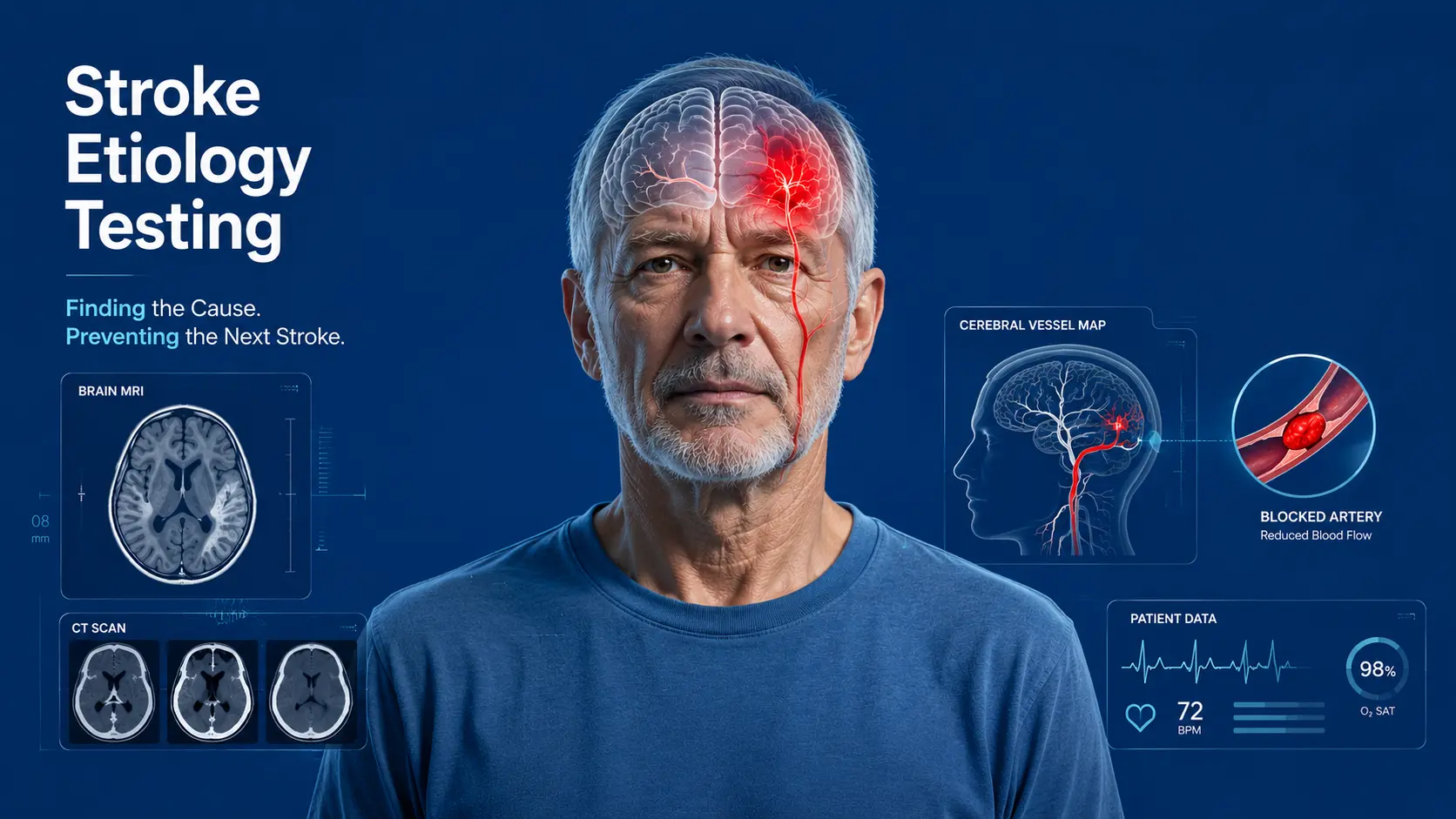
1. Computerized Tomography (CT)
A CT scan is almost always the first imaging test after a suspected stroke, often done within minutes of arriving at the hospital. Its main task is to answer an urgent question: Is this an ischemic stroke caused by a blood clot, or an intracerebral hemorrhage caused by bleeding inside the brain? A radiologist and a neurologist usually review these images together within minutes, because the answer determines which medications are safe to give right away.
This distinction makes all the difference in immediate treatment. The blood clot-busting drugs that help with ischemic strokes can be dangerous in hemorrhagic strokes, so a CT scan is usually done before any medications are given.
2. Magnetic Resonance Imaging (MRI)
MRI provides much more detailed images of brain tissue than CT scans and is particularly useful in detecting small or early strokes that may not be detected on CT scans. MRI helps confirm the exact location and size of the affected area, which can point to a specific cause. For example, several small strokes spread across both sides of the brain often point to a cardioembolic source, whereas a single stroke confined to a specific blood vessel area may point to large artery disease. This distinction is important because it directly determines which of the remaining tests a neurologist will subsequently prioritize.
3. Carotid Ultrasound
The carotid arteries run along both sides of the neck and are a major route of blood supply to the brain. A carotid ultrasound uses sound waves to examine narrowing (stenosis) caused by plaque buildup. It is a painless, noninvasive test and is a key part of this evaluation, as carotid artery disease is one of the most common — and most easily treatable — causes of ischemic stroke. People with significant narrowing of the blood vessels are often candidates for procedures that can significantly reduce the risk of another stroke.
4. Cerebral Angiogram
A cerebral angiogram creates a detailed map of the blood vessels inside the brain. It can be done nonsurgically (CT angiogram or MR angiogram) or, in more complex cases, through a catheter-based procedure. This test is especially valuable when a neurologist suspects an aneurysm, arterial dissection, vasculitis, or other structural abnormality of the blood vessels that cannot be fully diagnosed with carotid ultrasound and conventional imaging.
5. Echocardiogram
Not all strokes start in the brain’s own blood vessels — many strokes start in the heart. An echocardiogram uses ultrasound to examine the chambers and valves of the heart, looking for blood clots, structural abnormalities, or holes in the chambers (such as a patent foramen ovale) that could allow a blood clot to travel to the brain. This test is essential for younger patients or those who do not have obvious risk factors, such as high blood pressure or smoking, as otherwise a heart condition may be completely missed.
6. Blood and Laboratory Tests
As part of a complete workup, tests are performed for blood clotting problems, infections, inflammation, cholesterol abnormalities, and blood sugar levels. In selected patients, more specialized panel tests or genetic testing may be ordered to diagnose blood clotting problems, especially when a stroke occurs at a young age without any obvious cause. Together, these six components provide a neurologist with a complete and multidimensional picture rather than a single fragmentary picture.

Stroke Diagnosis Tests at a Glance
| Test | What the test assesses | Why it’s important |
|---|---|---|
| Complete neurological exam | Identifies areas of the brain that may be affected by a stroke | Localizes the likely area of the brain affected |
| CT scan | Bleeding vs. obstruction | Helps determine bleeding vs. obstruction |
| MRI | Detailed patterns of brain tissue and stroke | Detects small or early strokes that may not be seen on a CT scan |
| Carotid ultrasound | Narrowing of the arteries in the neck | Detects plaque buildup, a major cause of stroke |
| Cerebral angiogram | Structure of the blood vessels in the brain | Detects aneurysms, dissections, or blood vessel disease |
| Echocardiogram | Chambers and valves of the heart | Finds the source of a blood clot in the heart |
Who usually needs this type of test?
Not all patients need the full six-part evaluation described above. A neurologist will determine the type of test based on the patient’s age, medical history, and the type of symptoms seen on the initial exam. However, certain groups are almost always referred for a full evaluation:
- Patients under 55 years of age with no obvious risk factors such as high blood pressure, diabetes, or a history of smoking
- Patients with an irregular heartbeat, known heart murmur, or a history of heart failure
- Those who have already had a stroke or TIA and are at high risk of having another one
- Whose symptoms do not clearly fit a single, specific vascular pattern
- Those with a family history of stroke at a young age or known blood clotting problems
In each of these situations, avoiding thorough testing can leave a treatable cause undetected — and it is very difficult to prevent a recurrence of an undetected cause.
Ischemic Stroke vs. Intracerebral Hemorrhage: Why Imaging Should Be Done Earlier
Neuroimaging is not just an adjunct — it is essential. The reason is simple: An ischemic stroke and an intracerebral hemorrhage can cause similar symptoms, yet they require different treatment approaches.
Imaging can also help identify conditions that mimic stroke, such as seizures, complicated migraines, low blood sugar, and brain tumors. This is why sudden neurological symptoms should be evaluated urgently, even if they resolve on their own — which is often the case with transient ischemic attacks (TIAs). This is a warning sign that a full evaluation to determine the cause of the stroke should not be delayed.
Common causes of stroke identified by diagnostic testing
After a thorough examination, most strokes fall into one of several categories:
- Atherosclerosis of large arteries — narrowing of major arteries due to plaque buildup, often detected by carotid ultrasound
- Cardioembolism — a blood clot in the heart that travels to the brain, usually found by echocardiogram
- Small vessel disease — blockage of the small arteries deep in the brain, often related to chronic high blood pressure or diabetes
- Strokes of other known causes — including arterial dissection, vasculitis, or blood clotting problems
- Cryptogenic stroke — a stroke in which, despite thorough testing to determine the cause of the stroke, no obvious cause can be identified
This classification system is widely used in neurology and is based on the National Center for Biotechnology Information’s classification of ischemic strokes, described in detail in sources such as the clinical reviews of the subtypes. Even in cryptogenic cases, testing is not in vain — ruling out the most common and most easily treatable causes helps to create a safe long-term prevention plan.

What happens after tests to diagnose the cause of a stroke?
Once the cause is identified, treatment shifts from diagnosis to prevention. Depending on the results, a neurologist may recommend the following:
- Blood thinners or antiplatelet drugs to prevent blood clots
- Blood pressure and cholesterol control
- Special procedures for severely narrowed carotid arteries
- Lifestyle changes, including diet, exercise, and smoking cessation
- A well-organized rehabilitation program to help you recover
The recovery process doesn’t stop once the tests and initial treatment are over. Many patients benefit from a well-organized plan in the weeks and months that follow — which we discuss in detail in our guide, 10 Recovery Tips to Avoid Post-Stroke Complications.
According to the American Stroke Association, about 80 percent of strokes are preventable, and a big part of that prevention starts with correctly identifying the cause of the first stroke.
Questions to ask during your follow-up appointment
Once the results are in, it’s helpful to be prepared for a follow-up visit. Consider asking your care team:
- What specific cause has been identified, and how confident is the team in that diagnosis?
- What medications are being recommended, and what are the risks of stopping them prematurely?
- Are there any additional tests needed, such as long-term heart rate monitoring?
- What lifestyle changes will have the greatest impact on my personal risk factors?
- How soon should I schedule a follow-up scan or lab recheck?
- What symptoms should I call the office again or go to the emergency department if they occur?
Bringing a written list — or having a family member with me to take notes — often makes these discussions more productive, especially in the days immediately following a hospital stay when patients are still recovering.
Life after diagnosis: Building long-term resilience in everyday life
A diagnosis is a starting point, not an end. Many of the lifestyle factors that contribute to a first stroke also increase the risk of a second stroke, so most treatment plans include realistic, sustainable changes in addition to medication:
- Controlling blood pressure. Home monitoring and regular check-ups can help catch problems before they become dangerous.
- Eat a heart-healthy diet. Cutting down on sodium, saturated fat, and processed foods can help keep both blood pressure and cholesterol levels within target ranges.
- Get regular exercise. Even light daily activity, with your care team’s approval, can help improve circulation and recovery.
- Quit smoking. Quitting smoking is one of the most effective ways to reduce your risk in the future.
- Regular follow-up. Skipping appointments is one of the most common and preventable causes of a second stroke.
None of these steps are a substitute for treatment, but together they can strengthen treatment. A clear diagnosis helps you know which of these factors are most important to you personally, rather than following general advice that may not apply to your situation.
Meet Your Neurologist
Testing for stroke is only as effective as the doctor’s interpretation of it. At Consultant Corner, evaluations are conducted by Sakib A. Chowdhury, MD, a fellowship-trained vascular neurologist and neurointensivist with extensive experience in the diagnosis and management of complex strokes. Dr. Chowdhury’s experience in vascular neurology and neurocritical care allows him to not only order the right tests, but also interpret them in light of the complete clinical picture, creating a treatment and prevention plan specifically tailored to each patient.
Consultant Corner: Neurological Services in Two Locations
Consultant Corner offers comprehensive stroke diagnosis and ongoing neurological services in two communities:
Bloomington, Illinois
Patients in Central Illinois can visit Consultant Corner (Neurological Services in Bloomington, Illinois) for stroke evaluation, imaging coordination, and long-term follow-up care. Learn more about our neurologist branch in Bloomington, Illinois, or read our detailed description of Neurological Services in Bloomington – Specialized Brain Health Services.
El Paso, Texas
Patients in West Texas can seek treatment at Consultant Corner (Neurological Services in El Paso, Texas), where our team follows the same rigorous approach to diagnosing stroke. Learn more about our Health Consultants branch in El Paso, Texas, or see 10 reasons why patients choose Consultants Corner for neurological care in Bloomington, Illinois and El Paso, Texas.
Our Partnership with MyCare Express Care
Consultant Corner is proud to partner with MyCare Express Care, a walk-in clinic located in Bloomington, Illinois. This partnership makes it easy for patients to move from an initial walk-in visit to a specialized neurological evaluation without unnecessary delays.
MyCare Express Care offers same-day evaluations for many of the symptoms that precede a stroke diagnosis, including headaches, dizziness, and minor injuries. In addition, they are now offering virtual neurology appointments as part of their wellness services. For patients who notice new or unusual neurological symptoms during a walk-in visit, this partnership helps ensure a rapid path to a stroke diagnosis and specialist, especially when time is of the essence.
When to Seek Emergency Care
Stroke diagnosis is performed after the patient is medically stable — but getting to that point begins with the recognition of an emergency. If you or someone you know has sudden facial droop, arm weakness, slurred speech, vision changes, or a severe and unexplained headache, call 911 immediately. Do not drive or wait for symptoms to improve. Every minute without treatment increases the risk of permanent brain damage.
If you have already had a stroke or TIA and want to understand the cause, a scheduled neurological evaluation and stroke diagnostic tests are necessary.
Frequently Asked Questions About Stroke Diagnostic Tests
How long does it take to diagnose a stroke?
In the hospital, initial imaging, such as a CT scan, can be done within minutes. The entire stroke diagnostic test process — which includes MRI, carotid ultrasound, cerebral angiogram, and echocardiogram — is completed within one to three days of being in the hospital, although some tests may also be done as an outpatient follow-up.
Are stroke screening tests painful?
No. CT, MRI, carotid ultrasound, and echocardiogram are all noninvasive and painless, although some patients may find it uncomfortable to lie still in an MRI machine for a short period of time. A catheter-based cerebral angiogram involves making a small incision and giving light sedation, and is usually well-tolerated and closely monitored by the care team throughout the procedure.
What if my stroke screening tests find no obvious cause?
This is called a cryptogenic stroke and is not uncommon. Even if there is no specific cause, testing can rule out the most dangerous and most easily treatable possibilities, which helps create a safe long-term prevention plan and may require additional monitoring, such as increased heart-rhythm monitoring.
Do I still need to have stroke screening tests if I have only had a TIA?
Yes. A TIA (mini-stroke) is a warning sign that a full-blown stroke may follow, and should be treated as an emergency. Identifying the cause early can significantly reduce the risk of future events.
Can I get a stroke diagnostic test without going to the ER?
If you are currently experiencing stroke symptoms, go to the emergency department or call 911 immediately — this is not something to put off. If you have been discharged from the hospital after a stroke or TIA and want a follow-up evaluation, or if you are at risk and want an active neurological evaluation, you can schedule a consultation directly with our office.
Schedule your stroke diagnostic test consultation
If you or a loved one has experienced a stroke, TIA, or any unknown neurological symptoms, understanding the cause is the most important step in preventing another one. Our team at Consultant Corner coordinates a full evaluation to diagnose the cause of your stroke and creates a treatment plan based on your specific results.
Contact us online to schedule a consultation, or call +1 888 208 2208 to speak with our team today.