
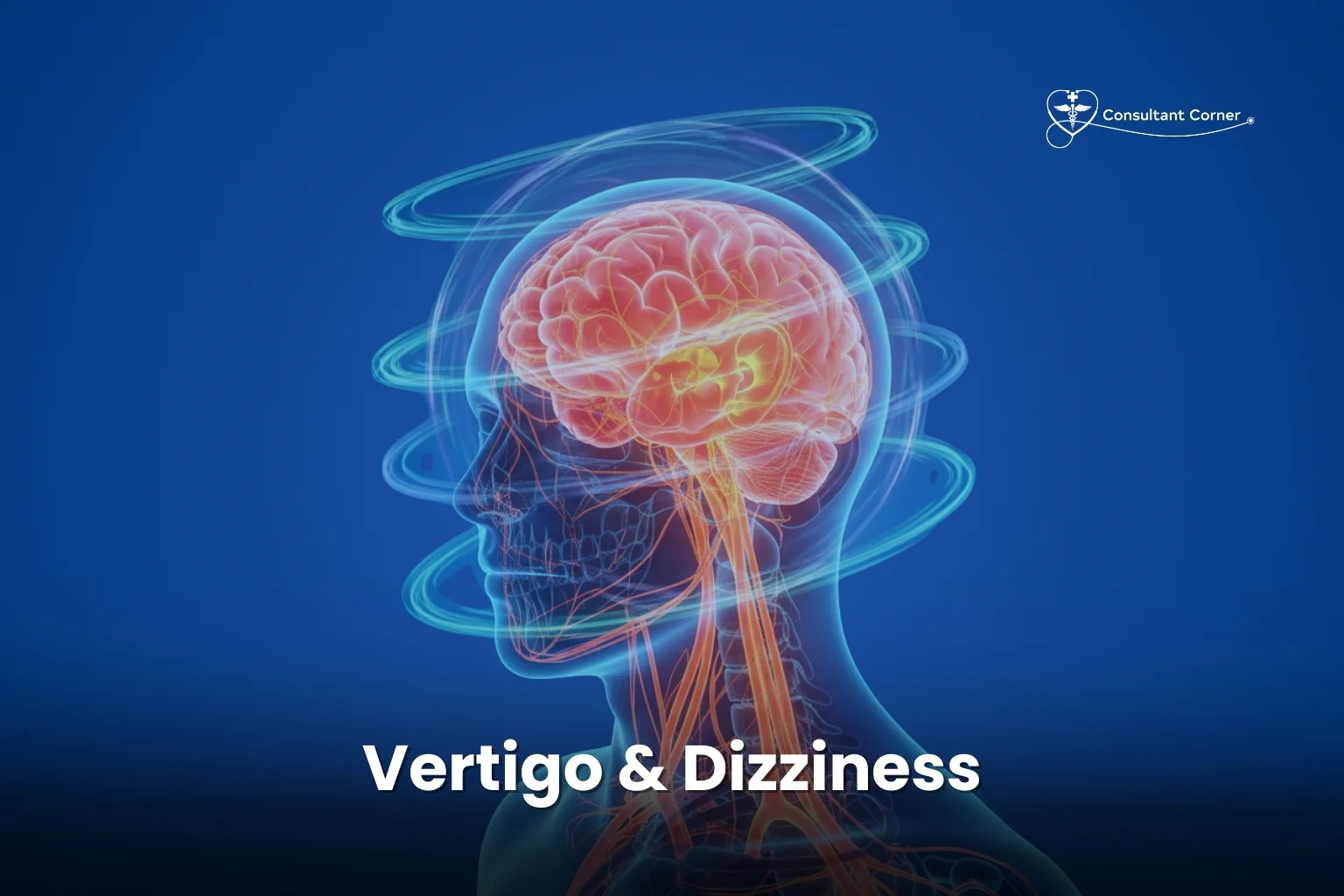
Vertigo and Dizziness – Get the Answers. Get Your Balance Back.
Vertigo and dizziness are two of the most uncomfortable symptoms a person can experience. One minute you’re standing at the kitchen counter, and the next it feels like the house is tilting to one side, your stomach is churning, and you’re reaching for something solid to hold on to. If this sounds familiar, you’re not mistaken, and you’re not alone. Millions of adults suffer from occasional dizziness, and for many of them, the uncertainty is as difficult as the symptom itself: What exactly is causing it, and is it dangerous?
At Consultant Corner, we specialize in finding the root cause of vertigo and dizziness — whether it’s in the inner ear, the brain, the nervous system, or something else entirely — so you can stop guessing and start feeling steady again.
In this guide, we’ll discuss what vertigo and dizziness actually are, what the most common causes are, when it should be considered a medical emergency, and how our neurology team in Bloomington, Illinois and El Paso, Texas diagnose and treat them. We’ll also tell you about our partnership with a local walk-in clinic that can help you get the treatment you need quickly. You’re not alone — and you don’t have to live with it.
You’re Not Alone — and You Don’t Have to Live With It
Vertigo and dizziness can be downright terrifying. The feeling of spinning, sudden loss of balance, nausea, lightheadedness, or the fear of falling at any moment — these aren’t your fault. They’re signals that some part of your inner ear, brainstem, or nervous system isn’t working properly.
The problem is, these symptoms often come and go. They appear, shake your confidence for a few minutes or hours, and then disappear — only to return days, weeks, or months later. This uncertainty is why many people delay seeking professional help. But recurrent vertigo and dizziness almost always have an identifiable cause, and most causes can be successfully treated once properly diagnosed.
👉 If dizziness is interfering with your ability to work, drive, sleep, or walk around your home with confidence, it’s time to talk to our team.
What Does Vertigo and Dizziness Actually Feel Like?
“Dizziness” is a broad term, and it means something different to almost everyone who uses it. At Consultant Corner, we begin every assessment by helping patients define exactly what they’re feeling, as this description is a clue to the diagnosis itself.
- Vertigo — A false sensation that you or the room around you is spinning, tilting, or moving, even though you’re standing completely still.
- Presyncope — A lightheaded, “fainting” feeling, often accompanied by blurred vision or ringing in the ears.
- Disequilibrium — Feeling unsteady or off-balance when walking, but the room is not actually spinning.
- Nonspecific vertigo — A vague, floating, “lightheaded” feeling that doesn’t clearly fit into any of the categories above.
Each of these points to different possible causes, which is why an accurate description — and a proper neurological evaluation — are so important.

⚠️ When Dizziness Becomes a Serious Warning Sign
Not all dizziness requires emergency medical attention, but multiple symptoms together may signal a need to have your body examined more closely. If you experience any of the following symptoms, you should see a specialist and get checked out:
🟣 A sudden feeling of dizziness without warning (vertigo)
🔵 A feeling of fainting or dizziness
🟠 Difficulty walking, leaning to one side, or losing balance
🟢 Nausea, vomiting, or sensitivity to movement
🔺 Pressure in the head, blurred or double vision, or ringing in the ears (tinnitus)
🔸 Sudden onset and recurrence
If you notice even a few of these symptoms, it’s time to get checked out. Many causes of dizziness are treatable — but only when they’re properly identified.
👉 Don’t wait to fall. Call Consultant Corner today or request an appointment online.
🔍 Common Causes of Vertigo and Dizziness
One of the most important things to understand about vertigo and dizziness is that they are not a normal part of “getting older.” They are a symptom that has a specific, identifiable source. Below are some of the most common causes seen in our Neurology department.
Inner Ear Problems
The inner ear contains the vestibular system, a small but powerful structure responsible for your sense of balance. When it is disrupted, the brain receives conflicting signals about motion and position — and vertigo results. Common causes involving the inner ear include:
- Benign Paroxysmal Positional Vertigo (BPPV) — Tiny calcium crystals within the inner ear canal become dislodged, causing brief, sharp spinning sensations with certain head movements (such as turning over in bed or looking up).
- Vestibular neuritis or labyrinthitis — Inflammation of the vestibular nerve or inner ear, often following a viral illness, resulting in sudden and sometimes chronic dizziness.
- Meniere’s disease — A chronic condition of the inner ear, symptoms of which include occasional dizziness, hearing loss, ringing in the ears, and a feeling of fullness in the ears.
Migrainous Vertigo
Many people are surprised to learn that migraines are not always accompanied by headaches. Vestibular migraines can cause dizziness, sensitivity to movement, and imbalance, but headaches are rarely or never present. As a result, it is one of the most common causes of chronic dizziness that often goes undiagnosed.
Low Blood Pressure or Dehydration
A sudden drop in blood pressure — such as when you stand up too quickly, become dehydrated, have a blood clot, or are taking certain medications — can cause the brain to be deprived of oxygen for a short time, causing you to feel light-headed or faint.
Medication Side Effects
Dizziness is a common side effect of blood pressure medications, sleeping pills, certain antibiotics, and anticonvulsants. Reviewing your medication list with a specialist is an often overlooked but essential step.
Nerve and Brain-Related Causes
Since balance relies on constant communication between your inner ear, eyes, spinal cord, and brain, problems anywhere along that pathway — including the brainstem or cerebellum — can cause vertigo or imbalance.
Warning Signs of Stroke
In rare but serious cases, sudden vertigo can be an early sign of a stroke affecting the brainstem or cerebellum, sometimes called a posterior circulation stroke. This is one of the most important reasons not to ignore new, severe vertigo, especially if it is accompanied by other neurological symptoms. Our team also evaluates and treats ischemic strokes, and we know how to differentiate a benign inner ear problem from something that requires emergency medical attention.
Neck-Related Dizziness (Cervicogenic)
A stiff neck, whiplash, or cervical spine problem can sometimes disrupt the signals your brain needs for spatial orientation, causing dizziness or a feeling of imbalance that is made worse by certain neck movements.
Finding the exact cause from this list is the key to completely stopping the dizziness problem — not just suppressing it with medication that treats the symptoms but doesn’t solve the underlying problem.

Vertigo and Dizziness — Symptoms, Possible Causes, and Common Evaluations
| Symptom Type | Possible Cause | Common Evaluation |
|---|---|---|
| Short-term dizziness with head movement (turning to the side, looking up) | BPPV (positional vertigo) | Positional testing, repositioning maneuvers |
| Hearing loss, heaviness in the ears, or ringing in the ears | Meniere’s disease | Hearing test, vestibular workup |
| Dizziness with sensitivity to light/sound, little or no headache | Vestibular migraine | Neurology evaluation, review of migraine history |
| Lightheadedness upon standing up quickly | Low blood pressure/dehydration | Blood pressure test, review of body water balance |
| Sudden, severe vertigo with slurred speech, weakness, or vision loss | Possible stroke (emergency) | Immediate emergency evaluation |
| Increased imbalance with neck movement | Cervicogenic dizziness | Neurological and neck examination |
| Dizziness after starting a new medication | Medication side effect | Review medications with your doctor |
(This table is a general guide, not a definitive diagnosis. The only way to confirm the cause of your specific symptoms is a proper neurological evaluation.)
🏥 Why Patients Choose Consultant Corner
Living with uncertain vertigo and dizziness can have a serious impact on your confidence, independence, and daily life. Our approach is based on giving you fast, clear answers and an effective treatment plan.
🧠 Neurological Evaluation for Balance and Dizziness
We first identify whether your symptoms are coming from the inner ear, a nerve pathway, or directly from the brain. This distinction completely changes our treatment approach.
🔄 Vertigo Repositioning and Maneuvers
In the case of BPPV, a canal-repositioning maneuver performed in a chamber can often relieve symptoms on the same day.
📉 Migraine-Related Vertigo Treatment
Vestibular migraine is a leading and often overlooked cause of chronic dizziness. We help patients identify its causes and begin an effective treatment plan.
⚖️ Balance, Gait, and Fall Prevention Plans
For patients who suffer from persistent balance problems, we create a plan that helps reduce the risk of falls and restore confidence in daily activities.
🏡 Personalized Recovery Plan
Each patient’s plan is different — it includes specific exercises, therapy, medications as needed, and changes to fit your lifestyle.
⏱️ Same-Week Appointments
Dizziness can disrupt everything from driving to taking care of your family. That’s why we prioritize getting patients appointments quickly, rather than making you wait weeks for answers.
You can view our full range of neurological services on our Our Services page, and if your dizziness is also associated with migraine, our post on Understanding Headache & Migraine discusses this in more detail.
Get to Know Your Neurologist
Your evaluation will be conducted by Saqib A. Chaudhry, MD, a board-certified vascular neurologist and neurointensivist with extensive experience in diagnosing complex neurological symptoms, including balance, vertigo, and stroke-related conditions. You can read more about his background on our Our Doctors page.
🤝 Our Partnership with MyCare Express Care
For patients in the Bloomington, Illinois area, Consultant Corner works with MyCare Express Care, which offers a walk-in clinic and same-day non-emergency medical services. If you have sudden dizziness and need to be seen quickly before a full neurology evaluation can be scheduled, MyCare Express Care is a convenient option — they offer virtual neurology appointments in addition to their direct emergency services. Once your immediate symptoms have stabilized, our neurology team can take over for a full diagnosis and long-term treatment plan.
MyCare Express Care is located at 1404 Eastland Dr, Suite 103, Bloomington, IL 61701 and is open daily, including evenings and weekends — a helpful option if you have dizziness outside of regular office hours.
🚨 When Is Vertigo or Dizziness a Medical Emergency
Most causes of dizziness are not emergencies. But some combinations of symptoms should prompt you to call 911 immediately rather than schedule a regular appointment. If you experience dizziness along with the following symptoms, seek emergency medical attention:
⚡ Sudden weakness or numbness, especially on one side of your body
🗣️ Difficulty speaking or slurring
👁️ Sudden vision loss or double vision
🧠 A severe, sudden headache that you’ve never had before
😵 Sudden inability to walk or lose your balance
These could be signs of a stroke, and every moment counts. If you’re experiencing dizziness along with a head injury, it’s important to know the signs of a head injury, as concussions can cause similar symptoms.
The National Institute on Deafness and Other Communication Disorders (NIDCD) explains that a person feels unsteady or dizzy when standing, sitting, lying down, or walking due to a balance disorder — a helpful reminder that symptoms of a balance disorder can manifest in a variety of ways, depending on the underlying cause. You can read more about this on the NIDCD Balance Disorders page, a trusted source from the National Institutes of Health. For those who want to learn more about a specific diagnosis, the Vestibular Disorders Association also offers detailed patient support information at vestibular.org.
What to Expect During Your Vertigo and Dizziness Evaluation
Seeing a neurologist for the first time can be intimidating, especially when you’re not sure what’s wrong with you. Here is a general idea of how a Consultant Corner assessment for vertigo and dizziness is typically completed:
Step 1: Detailed Description
We will ask you to describe your symptoms — such as dizziness, floating, lightheadedness, or vertigo — in your own words. You will also be asked to describe when these symptoms started, how long they last, and what triggers them. Such descriptions can be very helpful, such as whether symptoms are aggravated by head position, standing up, or stress.
Step 2: A Specific Neurological and Balance Test
This may include testing your eye movements, checking your gait and coordination, and performing certain positional techniques (such as the Dix-Hallpike test) that can recreate and identify the symptoms of BPPV in the chamber.
Step 3: Additional Testing If Needed
Depending on what we find, we may recommend blood pressure monitoring, blood tests, hearing tests, or imaging such as an MRI to rule out a central (brain-based) cause.
Step 4: A Personalized Treatment Plan
Once we’ve identified a possible cause — or narrowed it down to a shortlist — we’ll walk you through a treatment plan step by step. This may include a repositioning maneuver performed in a chamber, a referral for vestibular therapy, migraine management, medication adjustments, or a combination of approaches tailored specifically for you.
The goal of each step is to be transparent. Vertigo and dizziness can seem confusing and unpredictable, but the diagnostic process itself doesn’t have to be.
Vertigo and Dizziness in the Elderly
While vertigo and dizziness can affect people of any age, older adults have some special considerations. Balance naturally relies on signals from the inner ear, eyes, and sensory nerves in the feet and legs, and age-related changes in any of these systems can cause imbalance. Add to that the fact that older adults are more likely to take multiple medications — some of which can cause dizziness as a side effect — and it’s easy to see why balance problems become more common with age.
The risks are also higher: a fall due to undiagnosed imbalance can lead to serious injuries, including broken bones or head injuries. That’s why we don’t think “mild dizziness” in older patients is something to ignore. A thorough evaluation can identify the underlying causes — such as drug interactions, inner ear changes, low blood pressure, or neurological causes — and can help create a fall-prevention plan that significantly reduces the risk.
Vertigo and Dizziness in Younger Patients
It’s a common misconception that vertigo only affects older people. Younger patients also often experience vertigo and dizziness, which are usually related to vestibular migraines, viral infections affecting the inner ear, anxiety-related dizziness, or dehydration. Because these causes are different from those commonly seen in older adults, a thorough medical history and specific physical examination are just as important for younger patients seeking relief.
Living with Chronic Dizziness: Practical Advice
While you wait for your evaluation — or as part of an ongoing management plan — there are some practical steps that can help reduce your risk of injury and ease everyday symptoms:
- Move slowly when getting up from bed and sitting.
- Keep your home well-lit, especially stairs and hallways.
- Remove loose carpets or clutter that could cause you to fall.
- Drink plenty of water, especially in hot weather or after exercise.
- Keep a simple record of when these problems occur, how long they last, and what you were doing — this information will be extremely helpful during your evaluation.
- Avoid driving or operating machinery during or immediately after these problems.
These steps are not a substitute for a diagnosis, but they can significantly reduce your risk until you get the answers you need.

Some Common Misconceptions About Vertigo and Dizziness
Misinformation about vertigo and dizziness is everywhere, and believing the wrong things can delay getting the right treatment. Let’s dispel some of the most common misconceptions.
Misconception: “It’s just a part of getting older.” Age can be a contributing factor, but dizziness isn’t something you have to accept lightly. There’s almost always an identifiable and treatable cause behind it.
Misconception: “If it goes away on its own, it’s not serious.” Many conditions, including BPPV and vestibular migraines, come and go. Just because symptoms go away between episodes doesn’t mean the underlying cause has resolved — it often means it’s just waiting to reactivate.
Misconception: “Dizziness is always an inner ear problem.” The inner ear is a common source, but dizziness can also be caused by changes in blood pressure, medication side effects, neurological disorders, or neck problems. This is why a proper evaluation looks at the whole issue, rather than assuming a single cause.
Myth: “There’s nothing you can do for chronic vertigo.” Even complex or chronic imbalances often respond well to a combination of vestibular therapy, medication, and lifestyle changes. Chronic doesn’t mean it’s untreatable.
Myth: “You should just rest and avoid movement until it goes away.” For certain causes, such as BPPV, controlled movement (through positioning techniques) is the real treatment. Avoiding all movement can sometimes delay recovery rather than speed it up. This is not something to assume on your own, but should be discussed with your doctor.
How Long Does Vertigo Usually Last?
The duration of an episode of vertigo is actually one of the most effective diagnostic clues. BPPV episodes are usually short-lived, lasting a few seconds to a few minutes, and are triggered by certain head movements. Vertigo caused by vestibular neuritis is more chronic, lasting from a few hours to a few days. Meniere’s disease episodes often last from 20 minutes to a few hours and are accompanied by auditory symptoms. Vestibular migraine episodes can last from a few minutes to a few days. If your dizziness does not clearly fit into any of these categories, then it is important to seek professional evaluation.
Frequently Asked Questions About Vertigo and Dizziness
Are vertigo and dizziness the same thing?
Not exactly. Dizziness is a broad term that can describe a variety of sensations, with vertigo specifically referring to a false sense of spinning or movement. Vertigo is a type of dizziness, but not all dizziness is vertigo.
Can anxiety cause dizziness?
Anxiety can cause dizziness or a feeling of floating, sometimes accompanied by rapid breathing or muscle tension. However, anxiety should not be assumed to be the cause without first ruling out inner ear, neurological, and heart-related causes, as the symptoms can be remarkably similar.
What is BPPV and how is it treated?
BPPV (benign paroxysmal positional vertigo) occurs when small calcium crystals in the inner ear become dislodged. It is one of the most common causes of vertigo and is often effectively treated with a repositioning maneuver in a chamber, which can sometimes resolve symptoms in a single visit.
When should I go to the emergency room for vertigo?
If dizziness is accompanied by sudden weakness, numbness, slurred speech, vision loss, severe headache, or inability to walk, go to the emergency room or call 911. These could be signs of a stroke and require immediate evaluation.
Do I need imaging tests to diagnose the cause of my vertigo?
Not always. Many causes, such as BPPV, can be diagnosed with just a physical exam and positional testing. However, if your symptoms suggest a neurological or vascular problem that needs to be ruled out, imaging tests, such as an MRI, may be recommended.
Can neck problems really cause dizziness?
Yes. Cervicogenic dizziness is a recognized cause, where a stiff neck, injury, or joint problem disrupts the sensory signals your brain uses for spatial orientation. It is usually made worse by certain neck positions or movements.
How soon can I see a doctor for vertigo or dizziness symptoms?
Consultant Corner offers same-week appointments for patients with active vertigo and dizziness symptoms, as we understand that these symptoms can seriously disrupt your daily life while you wait for answers.
📞 Take Control of Your Balance Again
You don’t have to walk around all day with your feet tiptoeing for fear of the next dizzy spell. A proper assessment can give you a clear picture of the real problem — and show you a clear path to stability and relief.
👉 Book Your Vertigo and Dizziness Appointment Today
📞 Call +1 888 208 2208 or request an appointment online with Consultant Corner — proudly serving patients in Bloomington, Illinois and El Paso, Texas.