
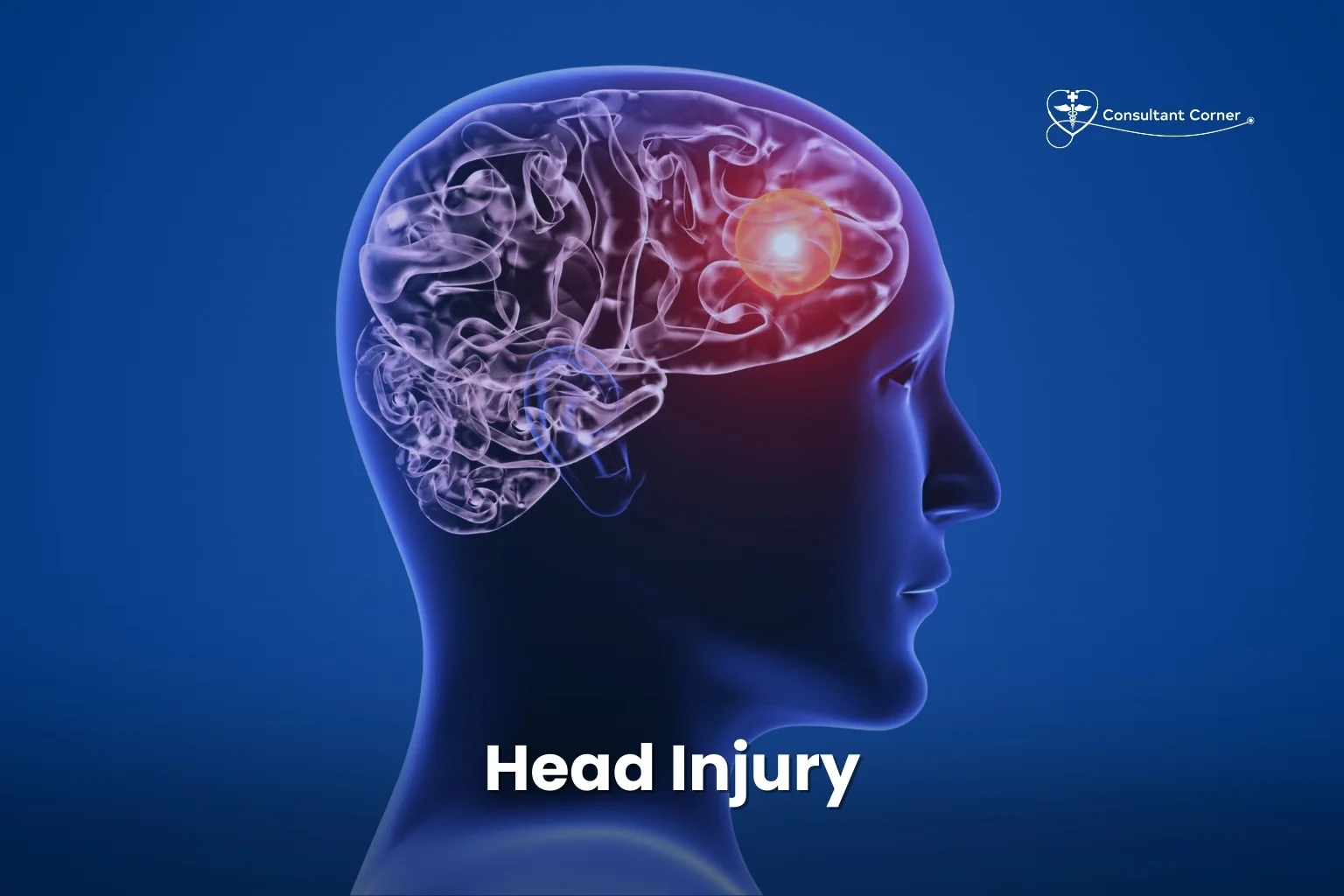
What Is a Head Injury? 7 Warning Signs to Know
A head injury: Any type of injury to the scalp, skull, or brain due to a fall, car accident, collision during sports, or any other blow to the head is called a head injury. Its severity can range from a minor injury that only causes a mild swelling to a severe brain injury that changes a person’s thinking, moving, or feeling for months or years to come. The most complicated aspect of a head injury is that it doesn’t always seem serious right away. Someone may feel completely fine after an accident, but hours or even days later they may develop a severe headache, confusion, or nausea.
At Consultant Corner, we assess patients every week for falls, car accidents, workplace injuries and sports collisions. Our goal with this guide is very simple: to help you understand what a head injury is, to detail the most important ones and to explain when you should see a neurologist rather than waiting at home.
What Is a Head Injury, Exactly?
In medical terms, a head injury refers to any damage to the scalp, skull, or brain tissue. Doctors usually divide these injuries into two main categories:
- Closed injury – The skull is intact, but due to the severity of the injury, it may penetrate the brain or cause bleeding inside it.
- Open (penetrating) injury – The skull may rupture or become perforated, and an object or fragment may enter the brain directly.
Within these categories, head injuries are further described according to their severity:
- Mild (often called a concussion) – brief confusion, headache, or dizziness with no lasting structural damage on imaging.
- Moderate – Prolonged confusion or unconsciousness, sometimes visible on CT or MRI scans.
- Severe – Significant bleeding, swelling, or structural damage, requiring immediate emergency medical treatment and often surgery.
It bears repeating: A serious head injury does not necessarily mean there are visible bruises, bruises, or loss of consciousness. Many patients who are later diagnosed with a concussion or even a small bleed on the brain never actually lost consciousness. According to the Mayo Clinic, even injuries described as “mild” are serious and require prompt treatment and proper diagnosis.

Common Causes of a Head Injury
Head injuries can occur in almost any setting, but the most common causes we see include:
- Falls at home, on stairs, or on ice (especially common in older adults and young children)
- Motor vehicle and motorcycle accidents
- Sports and recreational injuries, particularly contact sports and cycling
- Workplace accidents, including falls from height or being struck by equipment
- Physical assaults or violence
Understanding the cause is medically important. A low-speed fall in an older adult on blood thinners, for example, carries a very different risk profile than a teenager who was momentarily stunned during a soccer game — and both deserve proper evaluation for possible head injuries.
The 7 Warning Signs of a Head Injury You Should Never Ignore
Because the brain’s function can be disrupted even without a visible wound, it’s important to watch closely for symptoms in the hours and days after any blow to the head. Here are the seven warning signs our neurology team tells every patient to watch for:
| # | Warning Sign | What It Can Mean |
|---|---|---|
| 1 | Headache that won’t go away or keeps getting worse | Can be an early sign of concussion or bleeding inside the skull |
| 2 | Dizziness, imbalance, or feeling “off” | Often signals disruption in the brain pathways that control coordination |
| 3 | Nausea or vomiting | A common indicator of increased pressure inside the brain |
| 4 | Trouble focusing, remembering, or processing information | Many patients describe feeling “foggy” or unusually slow afterward |
| 5 | Sensitivity to light or blurry vision | Can appear days later and suggests irritation of the brain after trauma |
| 6 | Mood changes, irritability, or unusual emotional swings | Reflects how trauma can affect the brain’s emotional regulation centers |
| 7 | Sleep disturbances (sleeping far more or far less than usual) | A frequently overlooked but common after-effect of head injury |
If any of these seven signs show up — or get worse instead of better — it’s safest to be evaluated by a specialist promptly rather than waiting to see if things improve on their own.
Symptoms That Can Take Days to Appear
One of the most misunderstood things about head injuries is the delay in the onset of symptoms. Swelling, small amounts of bleeding, and inflammation inside the skull can build up slowly, causing someone to feel completely normal on the first day and then experience a severe headache, confusion, or vision changes on the third or fourth day. The CDC notes that brain injuries affect brain function and symptoms can appear long after the initial event. Because of this delayed onset of symptoms, close monitoring is recommended for at least the first 24 to 48 hours after any major injury, and for up to two weeks in the case of a concussion.
Why a Head Injury Should Always Be Taken Seriously
The consequences are unpredictable, and even a seemingly simple injury can sometimes lead to more serious complications, including:
- Brain injury and its long-term symptoms that affect attention, mood, and sleep for weeks or months
- Internal bleeding, such as epidural or subdural hematomas, which can put dangerous pressure on the brain
- Fractures in the skull, which may or may not be visible from the outside
- Persistent headaches, memory problems, mood swings, or sleep problems, sometimes called post-concussion syndrome
The National Institute of Neurological Disorders and Stroke (NINDS) explains that primary damage caused by a head injury can lead to secondary damage—which manifests itself hours to days after the original event—and this is one of the reasons why early assessment is so important for long-term recovery. Early detection of head injuries can prevent dangerous complications and dramatically improve recovery outcomes, especially when bleeding or swelling is caught before the emergency room arrives.
Children vs. Adults: Does Age Change the Risk?
Every patient is affected differently by head trauma. Children’s brains are still developing, and even minor injuries can sometimes affect their learning, attention, or school behavior if not treated properly. On the other hand, older people are more at risk for bleeding after a fall or injury — especially if they take blood-thinning medications or have a history of stroke — because brain tissue naturally shrinks with age, leaving more room for blood vessels to rupture during an injury. This is why a one-size-fits-all approach doesn’t work; each assessment should be based on the patient’s age, health history, and cause of the injury.
When to Go to the Emergency Room Immediately
Some symptoms after a head injury require emergency attention rather than a scheduled office visit. Call 911 or go to the nearest emergency room if you or a loved one experiences:
- Loss of consciousness, even briefly
- A sudden, severe headache unlike any before it
- Repeated vomiting
- Weakness or numbness on one side of the body
- A seizure
- Confusion or unusual behavior
- Clear fluid draining from the nose or ears
- Unequal pupil size
If you’re unsure whether it’s an emergency, it’s always safer to get evaluated than to wait and hope symptoms pass.
When It’s Not an Emergency, But You Still Need to Be Seen: Our MyCare Express Care Partnership
Not all head injuries require a trip to the emergency room — but they should never be ignored. That’s why Consultant Corner has partnered with MyCare Express Care, a walk-in clinic located at 1404 Eastland Drive, Suite 103 in Bloomington, IL. MyCare Express Care sees patients for minor injuries, concussions, sprains, and on-site X-ray services, with same-day service available seven days a week. If you have a head injury that doesn’t clearly require a trip to the emergency room, but you want to get it checked out quickly, MyCare Express Care can evaluate you and coordinate directly with our neurology team at Consultant Corner if further follow-up is needed — providing you with a clear and connected pathway from emergency care to specialist care under one seamless system.

How Consultant Corner Evaluates and Treats a Head Injury
We understand that this type of trauma is frightening — both for the injured person and for the family who are on the lookout for warning signs. From the moment you walk in, our goal is to provide you with reassurance, transparency, and expert medical advice. When you come to Consultant Corner for a head injury assessment, your services include:
- Specialist neurology assessment performed by a physician experienced in concussion and brain injury care
- Review of scans and ER reports, so if you’ve already visited the emergency room, we help interpret your CT or MRI findings and explain what they actually mean for your recovery
- A personalized recovery plan, whether that means rest, a gradual return to work or school, or further testing
- Management of ongoing symptoms, including headaches, dizziness, concentration issues, sleep problems, and memory lapses
- Same-week appointments, because you shouldn’t have to wait when brain health is on the line
Our care is led by Saqib A. Chaudhry, MD, a vascular neurologist and neuro-intensivist who works with patients recovering from head injury, ischemic stroke, and other neurological conditions. This same level of specialized, board-certified expertise is available whether you visit our neurologist in Bloomington, Illinois or our health consultant in El Paso, Texas.
Our service is led by Dr. Saqib A. Chaudhary, who is a vascular neurologist and neuro-intensivist. He treats patients recovering from head injuries, ischemic strokes and other neurological conditions. Whether you visit our neurologist in Bloomington, Illinois or our health consultant in El Paso, Texas, you’ll get this same level of specialized, board-certified expertise.
What Recovery From a Head Injury Typically Looks Like
Most people with a mild head injury or concussion recover fully within a few weeks with the right guidance — rest early on, followed by a gradual, monitored return to normal activity, work, screens, and exercise. Pushing back into full activity too soon is one of the most common reasons recovery takes longer than expected, since the brain needs time to settle before it can safely handle its usual workload again. For moderate to severe cases, recovery is longer and more individualized, often involving a team that may include neurology, rehabilitation therapy, and close imaging follow-up.
Most people with mild head injuries or concussions recover fully within a few weeks with the right guidance — rest at first, then a gradual and supervised return to normal activities, work, screen time, and exercise. Returning to full activity too quickly is one of the main reasons recovery takes longer than expected, as the brain needs time to re-stabilize to safely handle its normal workload. In moderate to severe cases, recovery takes longer and varies from person to person, often involving a team that may include neurology, rehabilitation therapy, and intensive imaging follow-up.
Prevention: Practical Steps That Actually Help
While not every head injury can be prevented, a number of everyday precautions meaningfully lower the risk:
- Wear a properly fitted helmet for cycling, motorcycling, skiing, and contact sports
- Use seatbelts and appropriate child car seats on every ride, not just long trips
- Remove fall hazards at home, such as loose rugs, poor lighting, and cluttered stairways
- Install handrails and grab bars for older adults or anyone with balance concerns
- Follow return-to-play guidelines closely after any sports-related concussion, rather than rushing back
- Keep blood pressure and blood-thinning medications well managed under a doctor’s supervision, since uncontrolled levels raise the risk of bleeding after even a minor impact
Small changes like these won’t eliminate the risk of a head injury entirely, but they meaningfully reduce both how often one happens and how severe it tends to be when it does.
Common Myths About Head Injury, Debunked
Misinformation about head injury is everywhere, and some of it can actually delay proper care.
Myth: “If there’s no bump or bruise, it wasn’t serious.” The skull and scalp can look completely normal while the brain itself is bruised or bleeding underneath. Severity is defined by what’s happening to the brain, not by visible marks on the outside.
Myth: “You have to lose consciousness for it to be serious.” As mentioned earlier, this isn’t true. Many patients with a meaningful head injury never black out, and instead notice a cluster of symptoms like headache, confusion, and nausea that build over the following hours.
Myth: “Once the headache goes away, you’re fully healed.” Headache is often the first symptom to improve, but that doesn’t always mean the underlying injury is resolved. Concentration problems, sleep disturbances, and mood changes can linger after the headache itself fades, which is why a full evaluation matters more than symptom-by-symptom tracking.
Myth: “A second head injury is basically the same as the first.” It isn’t. A second head injury that happens before the brain has fully recovered from the first — sometimes called second-impact risk — tends to produce more severe and longer-lasting symptoms. This is a major reason athletes are held to strict return-to-play protocols.

Living With the Long-Term Effects of a Head Injury
For most people, recovery happens within a matter of weeks. But a smaller group of patients go on to experience longer-term effects, and it helps to know what that can look like so it doesn’t catch you off guard:
- Persistent headaches that behave differently than the headaches a person had before the injury
- Cognitive changes, such as slower processing speed, word-finding trouble, or difficulty multitasking
- Emotional shifts, including increased irritability, anxiety, or low mood
- Sleep disruption, ranging from insomnia to excessive daytime fatigue
- Sensory sensitivity, particularly to light, noise, or screens
None of these symptoms indicate a permanent problem. In most cases, they are well-resolved with a well-organized plan, which may include gradual activity restriction, vision or vestibular therapy, sleep management, and medication for headaches or mood symptoms as needed. The key is to monitor your recovery over time with a doctor, rather than treating each symptom individually.
Returning to Work or School Safely After a Head Injury
Returning too quickly to a demanding job, a full class schedule, or intense screen time after a head injury can slow recovery and bring symptoms back. Most specialists recommend a stepwise return: starting with light cognitive and physical activity, then gradually increasing workload as symptoms stay stable. A neurologist can help build this plan around your specific job, sport, or academic demands, so you’re not guessing about when it’s safe to push further.
Frequently Asked Questions About Head Injury
Is every head injury a concussion?
No. A concussion is one specific type of mild head injury that temporarily affects brain function, but the term “head injury” is broader and also includes skull fractures, scalp lacerations, and more severe traumatic brain injuries involving bleeding or swelling.
How long do head injury symptoms usually last?
Most mild cases improve within one to three weeks, though some people experience lingering effects, sometimes called post-concussion syndrome, that last longer and benefit from specialist follow-up.
Can a head injury be serious even without losing consciousness?
Yes. Many people with a significant head injury never lose consciousness at all. Headache, confusion, dizziness, and nausea can indicate a meaningful injury even when the person stayed fully awake and alert.
Should I let someone go to sleep after a head injury?
Sleep itself isn’t dangerous, but it’s reasonable to check on the person periodically in the first few hours to make sure they can be woken normally and aren’t developing new symptoms like vomiting or worsening confusion.
When should I see a neurologist instead of just my primary care doctor?
If symptoms are worsening, lasting more than a week or two, or involve neurological changes like memory problems, vision changes, or persistent dizziness, a neurologist can provide a more detailed evaluation, review your imaging, and build a targeted recovery plan for your head injury.
Do I need a CT scan every time?
Not necessarily. Imaging decisions depend on factors like your symptoms, age, medications, and how the injury occurred. A specialist can help determine whether imaging is needed or whether close monitoring is the safer, more appropriate next step.
Trusted External Resources on Head Injury
For additional reading on head injury and traumatic brain injury from trusted medical organizations, see:
- Mayo Clinic: Traumatic Brain Injury — Symptoms & Causes
- CDC: Traumatic Brain Injury & Concussion
- NINDS: Traumatic Brain Injury (TBI)
Related Reading on Our Blog
- Neurologist in Bloomington, Illinois – Learn more about neurological care at Consultant Corner’s Bloomington, IL location.
- Health Consultant in El Paso, Texas – Learn more about our El Paso, TX neurology and consulting services.
- 12 Early Ischemic Stroke Symptoms That Could Save Your Life
- 11 Migraine Triggers That Could Be Causing Your Headaches
- 10 Early Alzheimer’s Disease Symptoms You Should Never Ignore
You may also be interested in our related neurology topics: ischemic stroke, headache and migraine, and Alzheimer’s disease — all conditions our neurology team evaluates and treats alongside head injury care.
Schedule Your Head Injury Evaluation Today
If you recently had a head injury and you’re not feeling like yourself, trust your instincts. Your brain is too important to ignore new or worsening symptoms, and early evaluation makes a real difference in how smoothly you recover.
Consultant Corner is here to help you get answers, feel better, and recover safely, with locations serving Bloomington, IL and El Paso, TX.
👉 Contact us online to book your head injury evaluation, or call our office directly to schedule a same-week appointment.




24 Comments
Very informative and important post. Head injuries can sometimes show serious symptoms hours or even days later, so knowing these warning signs can really help people seek medical attention at the right time.
great job sir,
Your service is Very well,
Thank you sir
I really appreciated reading your suggestions regarding head injuries. Nowadays, head injuries can happen to anyone. Reading this has given me a detailed understanding of why and how these injuries occur.
Thanks for the Information it’s a very good website
Informative and important post. Head injuries can sometimes show serious symptoms hours or even days later, so knowing these warning signs can really help people seek medical attention at the right time.
great job sir,
Your service is Very well,
Thank you sir
I am very happy because your service very smart.
These information helps me a lot.Now I know well about it
It’s very impressive. My pain is gone . Very trusted
Very useful and informational article.
This website and advise is very helpfull for me. Thank you very very much.
Great article on head injuries and the key warning signs to watch for! 🧠 This information is so important for everyone to know, especially after falls, sports collisions, or accidents. Awareness can make a real difference in getting timely help. Thanks for sharing these valuable insights! 👍
A silent fracture in the day,
Where thoughts drift soft and slip away.
With patient strength and quiet rest,
The inner world heals at its best.
Thank you for outlining the differences and causes so clearly. It is a great reminder of why we should always trust our instincts and seek professional medical advice after any accident.
This is such a clear, reassuring, and informative FAQ guide! Head injuries can be really overwhelming and stressful to navigate, but breaking down these common misconceptions—especially around loss of consciousness and sleep safety—is so helpful. Thank you for sharing such crucial health information to help keep people safe!”
This is a very important and timely piece of information! Often we don’t take minor injuries seriously, but they can cause major internal problems. Everyone should be aware of this.
Borsha rany Tithi
Thank you for your information
I have now know how to face it..
I am so happy.. Because Head injuries should never be taken lightly .. your service your patient very helpful…
Very useful information! Head injuries should never be taken lightly, and knowing these warning signs can truly make a difference. Thank you for sharing such an important awareness message. Stay safe, everyone! ❤️
This is such an important and informative topic. Knowing the warning signs of a head injury can help us recognize serious problems early and seek medical attention when needed. Thank you for sharing this valuable information! 🙏
Very informative and important post. Head injuries can sometimes show serious symptoms hours or even days later, so knowing these warning signs can really help people seek medical attention at the right time.
I’m very happy because your this service ❤
The thought of head injury is just amazing,its related to part of our daily life
I’m very happy because your this service is very great