TIA (Mini-Stroke): 7 Alarming Warning Signs You Must Never Ignore
TIA (Mini-Stroke) is one of the most misunderstood — and most dangerous — warning signs in all of neurology. A TIA, short for Transient Ischemic Attack, is sometimes brushed off simply because the symptoms fade so quickly. A hand goes numb for a few minutes, or speech slurs for a moment, and then everything seems normal again. But a TIA (Mini-Stroke) is never “nothing.” It is the brain’s way of sending an urgent message: a full-blown stroke may be on the way, and it could happen within hours or days, not months.
At Consultant Corner, our neurology team treats every suspected TIA (Mini-Stroke) as a true emergency, because the data backs that urgency up completely.
🚨 1 in 3 patients who experience a TIA (Mini-Stroke) will go on to have a major stroke.
🚨 Up to 50% of those strokes occur within the first 48 hours after the initial event.
That combination — a fleeting warning followed by a very real, very fast danger — is exactly why urgent evaluation matters so much. If you or someone you love had sudden neurological symptoms that came and went, please don’t wait it out. Treat it as an emergency and call us immediately.
What Is a TIA (Mini-Stroke), Exactly?
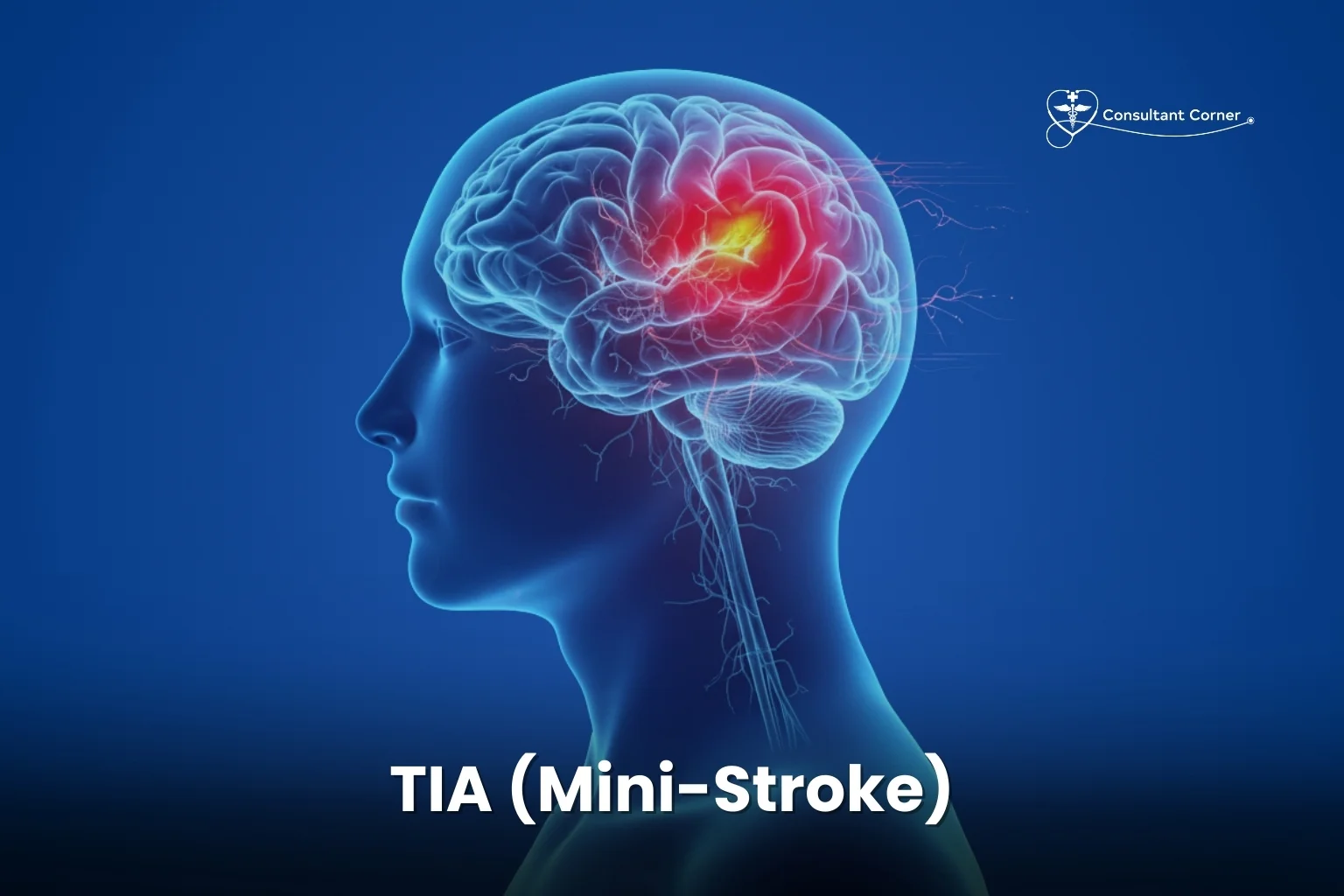
A Transient Ischemic Attack, widely known as a mini-stroke, happens when blood flow to part of the brain is temporarily blocked — usually by a small clot or a piece of plaque. Unlike a full stroke, the blockage in a TIA (Mini-Stroke) clears on its own before it can cause permanent brain tissue death. That’s the “transient” part of the name.
But here’s the part that trips people up: just because the tissue survives doesn’t mean the danger has passed. According to the American Heart Association, roughly 240,000 Americans experience a TIA every year, and it is widely recognized as one of the strongest predictors of a future stroke. Some research places the 90-day stroke risk after a TIA as high as 17.8%, with almost half of those events happening within just two days of the original episode. In other words, the clock starts ticking the moment symptoms appear — even if those symptoms are gone by the time you read this sentence.
Think of a TIA (Mini-Stroke) as a fire alarm rather than the fire itself. Ignoring the alarm doesn’t mean the building is safe.

⚠️ Common Symptoms of TIA (Mini-Stroke)
Symptoms of a TIA (Mini-Stroke) usually appear suddenly and can affect any part of the body controlled by the brain. They typically resolve within a few minutes to an hour, though some can linger longer. Watch for:
- 😵 Sudden weakness or numbness, usually on one side of the body
- 🗣️ Slurred speech or trouble finding the right words
- 👁️ Vision loss, double vision, or temporary blindness in one eye
- ⚖️ Dizziness, loss of balance, or a sudden inability to walk steadily
- 🧠 Confusion or difficulty understanding what others are saying
- 🤕 A sudden, severe, unexplained headache
- 😐 Drooping on one side of the face
Because a TIA (Mini-Stroke) resolves so quickly, many people convince themselves it was “just a weird moment” — dehydration, stress, or standing up too fast. That assumption is exactly what makes TIA (Mini-Stroke) so dangerous. The symptoms disappear, but the underlying vascular problem that caused them usually does not.
At a Glance: TIA (Mini-Stroke) vs. Ischemic Stroke
| Feature | TIA (Mini-Stroke) | Ischemic Stroke |
|---|---|---|
| Duration of symptoms | Minutes to under 24 hours | Persistent, does not resolve on its own |
| Brain tissue damage | Typically none | Often permanent without rapid treatment |
| Cause | Temporary clot or blockage | Blockage that cuts off blood flow long enough to cause tissue death |
| Urgency level | Medical emergency — same as a stroke | Medical emergency — call 911 immediately |
| Long-term risk | High risk of a major stroke soon after | Risk of a second stroke without prevention plan |
If you take away one thing from that table, let it be this: a TIA (Mini-Stroke) should be treated with the exact same urgency as an ischemic stroke, even though the symptoms fade. For more on how a full stroke unfolds and what the earliest signs look like, take a look at our related article, 12 Early Ischemic Stroke Symptoms That Could Save Your Life.
Why Does a TIA (Mini-Stroke) Happen?
A TIA (Mini-Stroke) doesn’t happen randomly. It’s almost always the result of an underlying vascular or cardiac issue that has been quietly building for years. The most common causes include:
- Small blood clots that temporarily block blood flow to the brain
- Carotid artery disease (narrowing of the arteries in the neck)
- Atrial fibrillation, an irregular heartbeat that allows clots to form in the heart
- High blood pressure, the single biggest risk factor for both TIA and stroke
- Diabetes and high cholesterol
- Vascular inflammation
- A personal or family history of stroke or previous TIA
- Advancing age — stroke and TIA risk roughly doubles every decade after age 55
- Smoking or long-term tobacco use
Many of these risk factors overlap with the causes behind other neurological and vascular events we treat regularly, including headaches tied to vascular changes and the earliest symptoms of cognitive decline. If migraines are part of your health picture as well, our guide on 11 Migraine Triggers That Could Be Causing Your Headaches breaks down how vascular and neurological symptoms can sometimes overlap.
A helpful way to think about it: a TIA (Mini-Stroke) is the body’s last warning shot before a potentially disabling stroke. The good news is that this warning gives patients and doctors a genuine window of opportunity — one that closes fast, but one that can meaningfully change the outcome when acted on.
Who Is Most at Risk for a TIA (Mini-Stroke)?
| Risk Factor | Why It Matters |
|---|---|
| High blood pressure | The leading cause of both TIA and stroke |
| Atrial fibrillation | Irregular heartbeat allows clots to travel to the brain |
| Diabetes | Damages blood vessels over time, raising clot risk |
| Smoking | Accelerates artery narrowing and clot formation |
| Age 55+ | Stroke and TIA risk increases significantly with age |
| Prior TIA or stroke | Strongest single predictor of a future event |
| High cholesterol | Contributes to plaque buildup in the arteries |

Why Patients Trust Consultant Corner After a TIA (Mini-Stroke)
When a TIA (Mini-Stroke) happens, patients and families are often left with more questions than answers. Was it really a TIA? What caused it? What happens now? Consultant Corner was built to answer those questions quickly, under the direction of Saqib A. Chaudhry, MD, a fellowship-trained Vascular Neurologist and Neuro-intensivist who focuses specifically on stroke prevention and rapid neurological evaluation.
✓ Comprehensive Neurology Evaluation
We take a detailed history of your symptoms, review your risk factors, and map out exactly what happened during your TIA (Mini-Stroke) — even if the episode has already resolved by the time you’re seen.
✓ Review of MRI/CT, Carotid Imaging & Heart Rhythm
If you were seen at a hospital or emergency room, we interpret those results in detail. If imaging wasn’t done, we order the appropriate studies urgently, since identifying the source of a TIA (Mini-Stroke) is essential to preventing the next event.
✓ Stroke Prevention Plan
This includes medication optimization for blood pressure, cholesterol, and clot prevention — the same categories of risk factors that drive most cases of TIA (Mini-Stroke) and ischemic stroke alike.
✓ Personalized Lifestyle & Risk Reduction Strategy
Every patient’s risk profile is different, so every prevention plan should be too. We tailor guidance around diet, activity, smoking cessation, and monitoring to reduce the odds of a future stroke.
✓ Fast Access — Same-Week Appointments
Because the highest risk period after a TIA (Mini-Stroke) is the first 48 hours, we prioritize getting patients in quickly. Post-TIA evaluation should never be delayed, and our scheduling reflects that urgency.
Consultant Corner serves patients through two locations: Consultant Corner (Neurological Care in Bloomington, IL), serving as a trusted Neurologist in Bloomington, Illinois, and Consultant Corner (Neurological Care in El Paso, TX), serving as a Health Consultant in El Paso, Texas. To learn more about how our Bloomington team supports the broader community, read Neurological Care in Bloomington – Expert Brain Health Services for Illinois.
Our Collaboration with MyCare Express Care in Bloomington, IL
Consultant Corner is proud to collaborate with MyCare Express Care, a walk-in clinic located at 1404 Eastland Dr, Suite 103, Bloomington, IL. This partnership matters directly for anyone concerned about TIA (Mini-Stroke) symptoms, because timing is everything.
MyCare Express Care offers extended hours — Monday through Friday from 7am to 7pm, and weekends from 10am to 4pm — along with walk-in access for urgent, non-emergency symptoms. They also offer virtual neurology appointments, giving patients in the Bloomington area an additional, convenient path to a neurology evaluation when something feels off. If your symptoms are still active or severe, calling 911 or going to the emergency room is always the right first step. But for follow-up care, risk factor management, or a same-day evaluation after milder symptoms, the combination of MyCare Express Care’s accessibility and Consultant Corner’s specialized neurology expertise gives Bloomington-area patients a faster, more complete safety net.

🚨 When TIA (Mini-Stroke) Symptoms Require Immediate 911
Some symptoms should never wait for a scheduled appointment — not with your primary doctor, not with a specialist, not even with a walk-in clinic. Call 911 immediately if you notice:
- Sudden weakness or numbness, especially on one side of the body
- Slurred or garbled speech
- A drooping face
- A severe, sudden headache unlike any you’ve had before
- Inability to speak, understand speech, or walk
Even if these symptoms last only a few seconds, they still qualify as a medical emergency. A quick way to remember the warning signs of both TIA (Mini-Stroke) and full stroke is the BE-FAST method:
BE-FAST: A Quick Way to Recognize TIA (Mini-Stroke) and Stroke
- Balance — Sudden loss of balance or coordination
- Eyes — Sudden vision changes in one or both eyes
- Face — Facial drooping on one side
- Arms — Arm weakness or numbness
- Speech — Slurred or difficult speech
- Time — Time to call 911 immediately
Related Reading From Consultant Corner
Understanding TIA (Mini-Stroke) often means understanding the broader picture of brain and vascular health. A few related articles from our blog may help:
- What Causes Ischemic Stroke?
- Understanding Headache / Migraine
- 10 Early Alzheimer’s Disease Symptoms You Should Never Ignore
- Millions of Americans Live with Chronic Neurological Disorders
- Brain Health Care in Texas: 10 Warning Signs You Shouldn’t Ignore
For additional independent, medically reviewed information on TIA (Mini-Stroke), the Cleveland Clinic’s overview of transient ischemic attack and the CDC’s stroke risk factor guidance are both excellent, trustworthy resources.
Life After a TIA (Mini-Stroke): What Recovery and Prevention Really Look Like
Because the symptoms of a TIA (Mini-Stroke) resolve on their own, many patients assume there’s nothing left to “recover” from. In a physical sense, that’s often true — most people return to their normal activities within hours. But the real recovery work happens behind the scenes, in the weeks and months after the event, when a neurologist helps identify and correct the underlying cause.
This typically starts with a thorough workup: brain and vascular imaging, heart rhythm monitoring, and blood work to check cholesterol and blood sugar. From there, most prevention plans include some combination of the following:
- Blood pressure management. Since high blood pressure is the single biggest driver of both TIA and stroke, getting numbers under control is usually priority one.
- Antiplatelet or anticoagulant therapy. Depending on the suspected cause, medications like aspirin, clopidogrel, or a direct oral anticoagulant may be prescribed to reduce clotting risk.
- Cholesterol-lowering treatment. Statins and lifestyle changes help slow or reverse plaque buildup in the arteries.
- Diabetes management. Better blood sugar control reduces long-term vascular damage.
- Smoking cessation support. Quitting smoking meaningfully lowers stroke risk within a relatively short period of time.
- Structured follow-up. Regular check-ins allow your care team to adjust the plan as your risk factors change.
Patients who stay engaged with this kind of follow-up care after a TIA (Mini-Stroke) tend to have significantly better long-term outcomes than those who let the episode fade into memory without a plan. That’s really the heart of what makes post-TIA care so valuable: it turns a frightening warning into a concrete, actionable roadmap for staying healthy.
Frequently Asked Questions About TIA (Mini-Stroke)
Is a TIA (Mini-Stroke) the same as a stroke?
Not exactly. A TIA (Mini-Stroke) involves a temporary blockage of blood flow to the brain that resolves on its own, typically without causing permanent tissue damage. A full stroke involves a blockage or bleed that does not resolve quickly, often leading to lasting damage. However, a TIA (Mini-Stroke) is treated as a medical emergency because it so strongly predicts a future stroke.
How long do TIA (Mini-Stroke) symptoms usually last?
Most TIA (Mini-Stroke) symptoms last anywhere from a few minutes to about an hour, though some can persist up to 24 hours. The short duration is exactly why so many people mistakenly dismiss the episode instead of seeking care.
What should I do if I think I had a TIA (Mini-Stroke) but the symptoms already went away?
Call your doctor or Consultant Corner right away, even if you feel completely normal now. If symptoms are still present, are severe, or return, call 911 immediately. A resolved TIA (Mini-Stroke) still requires urgent evaluation because the risk of a major stroke remains highest in the days immediately following the event.
Can a TIA (Mini-Stroke) happen more than once?
Yes. Some patients experience multiple TIAs before a major stroke occurs, while others have only one. Each TIA (Mini-Stroke), regardless of how many have occurred before, should be evaluated as a new emergency.
What tests are used to diagnose a TIA (Mini-Stroke)?
Common tests include brain imaging (MRI or CT), carotid artery imaging, and heart rhythm monitoring to check for atrial fibrillation. These tests help identify the underlying cause and guide the stroke prevention plan.
Can a TIA (Mini-Stroke) be prevented?
In many cases, yes. Managing blood pressure, cholesterol, diabetes, and atrial fibrillation, along with quitting smoking and following a prevention plan from a neurologist, can significantly lower the risk of both a first TIA (Mini-Stroke) and a subsequent stroke.
Is TIA (Mini-Stroke) more common in older adults?
Age is a major risk factor, and stroke and TIA rates increase significantly after age 55. However, TIA (Mini-Stroke) can occur in younger adults too, particularly those with high blood pressure, diabetes, smoking history, or heart conditions.
Don’t Wait for a Stroke — Take Action After a TIA (Mini-Stroke)
A TIA (Mini-Stroke) is the clearest possible warning that a major stroke may be coming. It is uncomfortable, it is frightening, and it is easy to want to move past it once the symptoms fade. But with timely evaluation and the right treatment plan, the risk of a full stroke after a TIA (Mini-Stroke) can be dramatically reduced.
If you or a loved one has experienced sudden neurological symptoms — even ones that resolved on their own — please don’t wait to find out why. Book your post-TIA evaluation with Consultant Corner today.
📞 Call +1 888 208 2208 or request an appointment online.
Consultant Corner provides neurological care under the direction of Saqib A. Chaudhry, MD, Vascular Neurologist and Neuro-intensivist, with locations serving Bloomington, Illinois and El Paso, Texas.