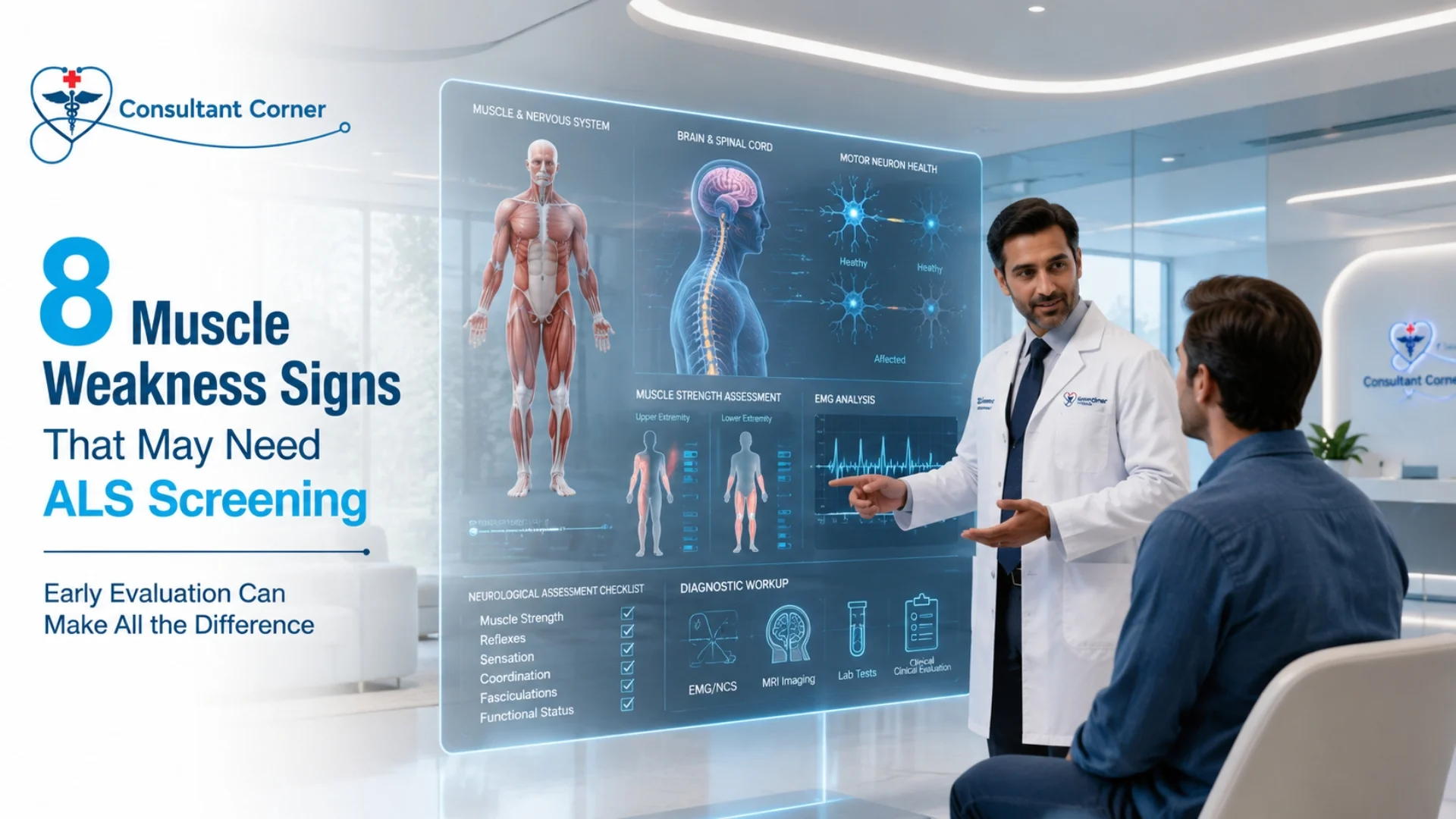
8 Muscle Weakness Signs That May Need ALS Screening
Feeling weaker than usual? Are you losing strength in your hands, feet, or arms? Don’t ignore it — an early evaluation can make a big difference.
Muscle weakness is one of the most common reasons patients make a neurology appointment, and in most cases, the cause is something that is treatable — like a pinched nerve, vitamin deficiency, thyroid problems, or disc herniation. But when muscle weakness worsens, spreads from one part of the body to another, or is accompanied by muscle spasms and unexplained fatigue, it’s important to rule out rarer but more serious neurological causes, including amyotrophic lateral sclerosis (ALS).
At Consultant Corner, muscle weakness and ALS screening are evaluated with the same urgency and precision. Our goal is simple: to quickly identify the real cause of your weakness, rule out what isn’t, and create a clear plan for moving forward — which could mean treating a treatable condition or connecting you with the right specialists for further testing.
This guide discusses eight symptoms of muscle weakness that you should pay closer attention to. It explains what causes muscle weakness in general and outlines what a thorough ALS screening actually involves.
Why Muscle Weakness and ALS Screening Matters
Most people who notice new weakness assume the worst and put off seeking treatment because of this fear. The truth is reassuring: The vast majority of muscle weakness has nothing to do with ALS. Nerve compression, neuropathy, and metabolic problems account for the majority of complaints of weakness seen in neurology clinics. However, because ALS is a progressive disease that significantly impacts early diagnosis and early treatment outcomes, screening for muscle weakness and ALS should never be delayed if the warning signs listed below are present.
Screening serves two purposes at once. First, it identifies and treats common, treatable causes of weakness, which affect the majority of patients. Second, it identifies the small number of patients in whom the primary neurological disease is present, so that treatment can be initiated as soon as possible.

8 Warning Signs of Muscle Weakness That Deserve Evaluation
If you notice any of the following symptoms, you should schedule an evaluation for muscle weakness and ALS screening rather than waiting to see if it will get better on its own.
1. Progressive Weakness in One Arm or Leg
Weakness limited to one side of the body — which is stable and continues to get worse over weeks or months — is a significant sign that doctors look for. Weakness that stays the same for months and doesn’t spread is much less of a concern than weakness that keeps getting worse.
2. Difficulty Lifting or Gripping Objects
Difficulty opening a jar, holding a coffee cup, or gripping a steering wheel can indicate a variety of problems, from carpal tunnel syndrome to cervical radiculopathy or early motor neuron changes. If the loss of hand strength is seen equally on both sides, it’s usually different than weakness limited to one hand — and usually less urgent.
3. Foot Drop or Frequent Stumbling
Foot drop occurs when the muscles that lift the front of the foot become weak, causing the toes to stick into the ground when walking. It’s a major symptom of peroneal nerve compression, but it can also be an early sign of a more widespread motor neuron problem, which is why it’s included in a thorough screening for muscle weakness and ALS.
4. Difficulty Lifting Your Arms or Climbing Stairs
Weakness in muscles closer to your body — such as your shoulders, hips, and thighs — rather than your arms and legs can be caused by a variety of conditions, including myopathy and some autoimmune muscle diseases. Difficulty raising your arms above your head or getting up from a chair are both symptoms you should tell your doctor about.
5. Muscle Twitching (Fasciculation)
Intermittent muscle twitching, especially in the muscles in the back of the legs or eyelids, is very common and almost always harmless. It is often related to caffeine, stress, dehydration or fatigue. When the twitching spreads to different parts of the body, is long-lasting and is accompanied by muscle weakness, it is worth investigating further during an ALS screening — twitching alone without weakness is rarely a sign of danger.
6. Unexplained Fatigue With Ordinary Activities
Feeling unusually tired after doing everyday tasks — such as climbing a flight of stairs, carrying groceries or combing your hair — can be a sign of anything from anemia and thyroid disease to primary neuromuscular weakness. Since fatigue can mimic the symptoms of many common diseases, it is difficult to diagnose the cause without proper testing.
7. Small or Shaky Handwriting
Noticeable changes in handwriting — such as smaller letters, shaky lines, or fatigue in the hands while writing sentences — can be a sign of fine motor weakness. Although this symptom is also associated with Parkinson’s disease, it is a sign of muscle weakness and should be included in the ALS screening checklist if there is progressive weakness in the limbs.
8. Slurred Speech, Difficulty Swallowing, or Voice Changes
When weakness begins to develop in the muscles used for speaking or swallowing — such as a nasal voice, slurred speech, or choking on liquids — this is a symptom that should be checked out immediately, as it can also be a sign of an acute stroke. Any sudden change here requires urgent attention.
What Causes Muscle Weakness? (Most of It Is Not ALS)
It bears repeating: Most muscle weakness is not ALS. A thorough screening for muscle weakness and ALS looks for all possible causes, including:
- Nerve compression and entrapment (such as carpal tunnel syndrome)
- Peripheral neuropathy
- Cervical or lumbar radiculopathy (pressure on a nerve root in the neck or lower back)
- Stroke or transient ischemic attack (TIA)-related weakness
- Myopathy (primary muscle disease)
- Thyroid problems, including hypothyroidism
- Vitamin deficiencies, especially B12 and vitamin D
- Autoimmune neuromuscular diseases, such as myasthenia gravis
- Side effects of medications, including certain statins and steroids
Since the symptoms of many of these diseases overlap, the evaluation for muscle weakness and ALS screening is different for each individual. It is done to systematically confirm or rule out the disease — not to jump straight to the worst-case scenario.
Who Is at Higher Risk of Developing ALS?
Understanding risk factors does not predict who will develop ALS, but it helps our team decide how closely to monitor certain patients during muscle weakness and ALS screening evaluations. Age is one of the most obvious signs — although ALS can technically occur at any age, symptoms usually appear between the mid-50s and mid-70s. Biological sex also plays a small role, with men being slightly more likely to be diagnosed than women, although the gap narrows significantly as they get older.
Family history is also an important factor. Most cases of ALS are thought to be sporadic, meaning they occur without a clear family history or identifiable genetic cause. In a small number of cases, it is familial, which is related to an inherited gene mutation. That’s why a detailed family history is part of a comprehensive evaluation for muscle weakness and ALS screening. Some studies have also suggested a possible link between previous head trauma, certain environmental or occupational exposures, and military service, although these relationships are still under investigation and do not apply to most patients with weakness.
It is important to emphasize that having one or more risk factors does not mean that a person will develop ALS, nor does having no risk factors mean that they will not. Risk factors only guide how thorough an evaluation should be — they are part of a larger clinical picture that includes the type of symptoms, the progression of the disease, and the results of physical examinations.
Muscle Weakness vs. ALS Symptoms: A Brief Comparison
The table below highlights the general differences between common, treatable muscle weakness and the more well-known types of symptoms for ALS. This is provided as a general guideline, not a means of diagnosis — only a clinical evaluation can determine the true cause of your symptoms.
| Characteristic | Generalized Muscle Weakness | ALS-Related Weakness |
|---|---|---|
| Onset | Often sudden or related to an injury, illness, or repetitive stress | Develops gradually, over weeks to months |
| Pattern | Often symmetrical (equal on both sides) or limited to a specific nerve pathway | Often begins in one limb or region, then spreads |
| Progression | Tends to stabilize or improve with treatment | Worsens over time |
| Associated symptoms | Numbness, tingling, pain | Muscle spasms, twitching, muscle wasting without pain |
| Speech/swallowing | Rarely affected (unless stroke-related) | May be affected as the disease progresses |
| Reflexes | May be normal, diminished, or occasionally increased, depending on the cause | Often shows a distinct combination of hyperactive and hypoactive reflexes |
| Response to treatment | Often improves with physical therapy, nerve decompression, or medication | Does not resolve with general treatments |
ALS Screening: What Our Team Does
ALS is a rare disease — it affects a small portion of the population — but because early treatment can impact quality of life and the course of the disease, screening should never be overlooked if risk factors are present. During muscle weakness and ALS screening visits, our neurology team focuses on the following:
- Progressive weakness that is stable or fluctuating, rather than worsening over weeks to months
- Muscle spasms or twitches, especially when accompanied by measurable weakness
- Weakness that spreads from one limb or area to another over time
- Difficulty speaking, swallowing, or breathing, which may indicate involvement of the muscles that control these functions
It is important to emphasize again: most patients with these symptoms do not have ALS. The goal of screening is not to panic patients — the goal is to provide clarity, confidently rule out serious disease, and in rare cases, detect the disease at an early stage, when it is most important to detect it early. According to the National Institute of Neurological Disorders and Stroke, an accurate diagnosis as early as possible gives the best chance of treatment being effective, and a neurologist experienced in ALS plays a central role in that diagnosis. The ALS Association similarly notes that ALS causes the progressive degeneration of motor neurons that connect the brain to the muscles. As such, a careful clinical workup is needed, rather than a single test, to differentiate it from more common and treatable causes of weakness.
How Muscle Weakness and ALS Screening Works at Consultant Corner
Expert Neurological Evaluation
Our first priority is to identify the exact source of your weakness — whether the problem is originating in the brain, spinal cord, peripheral nerves, or the muscles themselves. This distinction will shape everything else in your treatment plan.
ALS Screening and Neuromuscular Testing
For patients with severe symptoms (red-flags), we perform a specialized neuromuscular assessment to rule out ALS and other motor neuron disorders. This includes reviewing reflexes, muscle tone, and strength across multiple muscle groups.
Lab Testing and Imaging Review
Blood tests can identify treatable causes such as thyroid problems, vitamin deficiencies, and autoimmune markers, while imaging can help diagnose structural causes such as nerve compression or spinal cord problems. As needed, we can also order electromyography (EMG) and nerve conduction studies, which measure the electrical activity of muscles and the speed at which nerve signals are transmitted. These tests help to differentiate whether the source of weakness is the nerves, muscles, or the junction between the two, and they play a central role in supporting or ruling out a diagnosis of ALS.
As part of each muscle weakness and ALS screening visit, we also collect a thorough medical and family history from the patient. When the weakness began, whether it has spread, whether it is accompanied by pain or numbness, and whether any close relatives have had similar symptoms — these details help narrow down the list of possible causes before even a single test is done.
Personalized Treatment Plan
Once the cause is understood, we create a treatment plan that directly addresses treatable issues and preserves long-term muscle and nerve function, with an emphasis on measurable outcomes.
Same-Week Appointments
There should be no waiting lists for new or worsening weakness. We prioritize timely appointments so that patients get answers without unnecessary delays.
Our priorities throughout muscle weakness and ALS screening are simple: accurate answers, safety, and prompt treatment when needed.

When Is Muscle Weakness a Medical Emergency?
Some symptoms of weakness require emergency treatment rather than a scheduled medical visit. If the weakness is accompanied by the following symptoms, go to the emergency department immediately:
- Drooping on one side of the face
- Sudden difficulty speaking
- Sudden numbness, especially on one side of the body
- Lack of balance or coordination
- Trouble breathing
- Sudden inability to walk
A combination of these symptoms may indicate a stroke or spinal cord emergency, both of which require immediate treatment to prevent permanent damage. If you are unsure whether your symptoms are urgent, seek emergency evaluation first as a precautionary measure.
Readings on Neurological Symptoms
If you are researching muscle weakness and related neurological symptoms, these related articles may also be helpful:
- Carpal Tunnel and Nerve Entrapment: 10 Warning Signs
- Back Pain and Sciatica Relief: 10 Proven Ways to Get Long-Lasting Relief
- Ischemic Stroke: Early Warning Signs, Treatment, and Recovery
- Essential Tremor Treatment: 10 Expert Tips to Stop the Tremors
- Vertigo and Dizziness: 9 Common Causes
Two Locations, One Standard of Neurological Care
Consultant Corner sees patients concerned about muscle weakness, ALS screening, and related neurological conditions at two locations:
- Consultant Corner (Neurological Care in Bloomington, IL) – Neurologists in Bloomington, Illinois
- Consultant Corner (Neurological Care in El Paso, TX) – Health Consultant in El Paso, Texas
Frequently Asked Questions About Muscle Weakness and ALS Screening
Do muscle spasms always indicate ALS? No. Isolated muscle spasms, especially in the muscles in the back of the legs or eyelids, are very common and are usually related to caffeine, stress, dehydration, or overuse. Spasms only become more relevant for ALS screening when they are accompanied by measurable, progressive weakness.
How is ALS diagnosed? There is no single test that confirms ALS. Diagnosis is based on a neurological exam, a detailed history of symptoms, and tests such as electromyography (EMG) and nerve conduction studies. In addition, imaging and lab tests are also done to rule out other diseases that have symptoms similar to ALS.
What are the most common causes of muscle weakness? Nerve compression — such as carpal tunnel syndrome or a pinched nerve in the neck or lower back — is one of the most common causes of muscle weakness seen in neurology clinics. This is followed by peripheral neuropathy and vitamin or thyroid-related problems.
Should I get screened for ALS if the weakness is only in one hand? Weakness limited to one hand is often due to nerve entrapment, not ALS. However, if the weakness is increasing, spreading, or accompanied by muscle spasms, an evaluation is the safest way to be sure of the underlying cause.
How quickly does ALS progress? ALS varies from person to person, but it is usually a progressive disease, with symptoms getting worse over several months. This is why there is an emphasis on early muscle weakness and ALS screening — the earlier the progressive form of the disease is identified, the sooner treatment can be started.
Is muscle weakness curable? Many causes of muscle weakness — such as nerve compression, vitamin deficiencies, and thyroid problems — can be significantly improved or completely reversed with the right treatment, which is another reason not to delay an evaluation.
Get Answers to Your Muscle Weakness — Fast
Whether your symptoms are mild or frightening, you have the right to a clear understanding, not to rely on guesswork. Our team is able to quickly diagnose the cause of your muscle weakness and start the right treatment early, including physical therapy, medication, referral to further specialists, or regular monitoring.
Book your muscle weakness and ALS screening appointment today. Request an appointment online or call to speak with our team directly.