10 Warning Signs of a Head Injury You Should Never Ignore
A head injury can seem harmless one moment and turn serious the next. You might hit your head while getting out of a car, fall down the stairs, or get a minor jolt from your car — and you might feel fine. Then, hours or even days later, a headache sets in, your thinking may seem blurry, or the house may start spinning. These delayed symptoms are why it’s so easy to underestimate this type of injury and why it’s so important to take it seriously.
At Consultant Corner, our neurology team examines patients with head injuries every week, from athletes and recreational players to seniors who have had minor falls at home. Below, we’ll discuss 10 warning signs you should never ignore, explain why each is important, and outline exactly when you should see a neurologist — or go to the emergency room — within the same week of a head injury.
Why Head Injuries Require Immediate Attention
Every head injury is different because every brain responds differently to trauma. Head injuries can range from a mild concussion that heals on its own to a severe traumatic brain injury (TBI), which causes swelling, bleeding, or permanent damage. According to the Centers for Disease Control and Prevention, some symptoms of a serious brain injury may appear right away, while others may not appear for hours or days — which is why saying “I’m fine now” is not the same as saying “I’m out of danger.”
The danger with this type of injury is that the brain is a soft, delicate organ protected by a hard skull. A sudden jolt, impact, or rapid deceleration can cause the brain to move around inside the skull, stretching nerve fibers and, in more serious cases, causing bruising or bleeding. That’s why doctors tell anyone who has suffered this type of injury — even a “minor” concussion — to watch out for the warning signs below.
Common Causes of Head Injuries
Understanding how these injuries typically occur can help you identify your risk level. The most common causes include:
- Falls — a leading cause in people of all ages, but especially in young children and the elderly
- Motor vehicle collisions — including car, motorcycle, and bicycle accidents
- Sports and recreational activities — contact sports like football, hockey, and soccer, as well as cycling and skiing
- Workplace accidents — falling objects, machinery accidents, or falls from heights
- Physical collisions or assaults
Regardless of the cause, the same principle applies: any forceful blow, jolt, or sudden stop that jolts the brain inside the skull can cause permanent damage. So more important than the cause of the injury is how closely you monitor your symptoms after the injury.
Ways to Reduce Your Risk of Head Injuries
While not all accidents can be prevented, a few everyday habits can significantly reduce your risk:
- Wear a properly fitted helmet when biking, skiing, playing contact sports, and riding a motorcycle.
- Use seatbelts and appropriate car seats for children on every trip, even short ones.
- Remove fall hazards from your home, such as loose carpets, inadequate lighting, and untidy stairs.
- Install handrails and grab bars for older adults or those with balance problems.
- Follow return-to-play guidelines rather than rushing back to sports after a previous concussion.
These small precautions won’t eliminate the risk completely, but they can significantly reduce both the likelihood and severity of head injuries.
Children, the Elderly, and the Risk of Head Injuries
Two groups of people need extra care after any head injury: young children and the elderly. Children may not be able to describe symptoms like blurred vision or sensitivity to light, so parents should watch for signs like excessive crying, unusual sleepiness, or refusal to eat or breastfeed. Older adults, especially those taking blood thinners, are at higher risk of bleeding inside the skull after seemingly minor falls, and the symptoms can be subtle — often mistaken for simple fatigue or confusion rather than a medical emergency. If a child or an older family member falls or hits their head, it’s a good idea to see a doctor as a precaution, even if they initially seem fine.
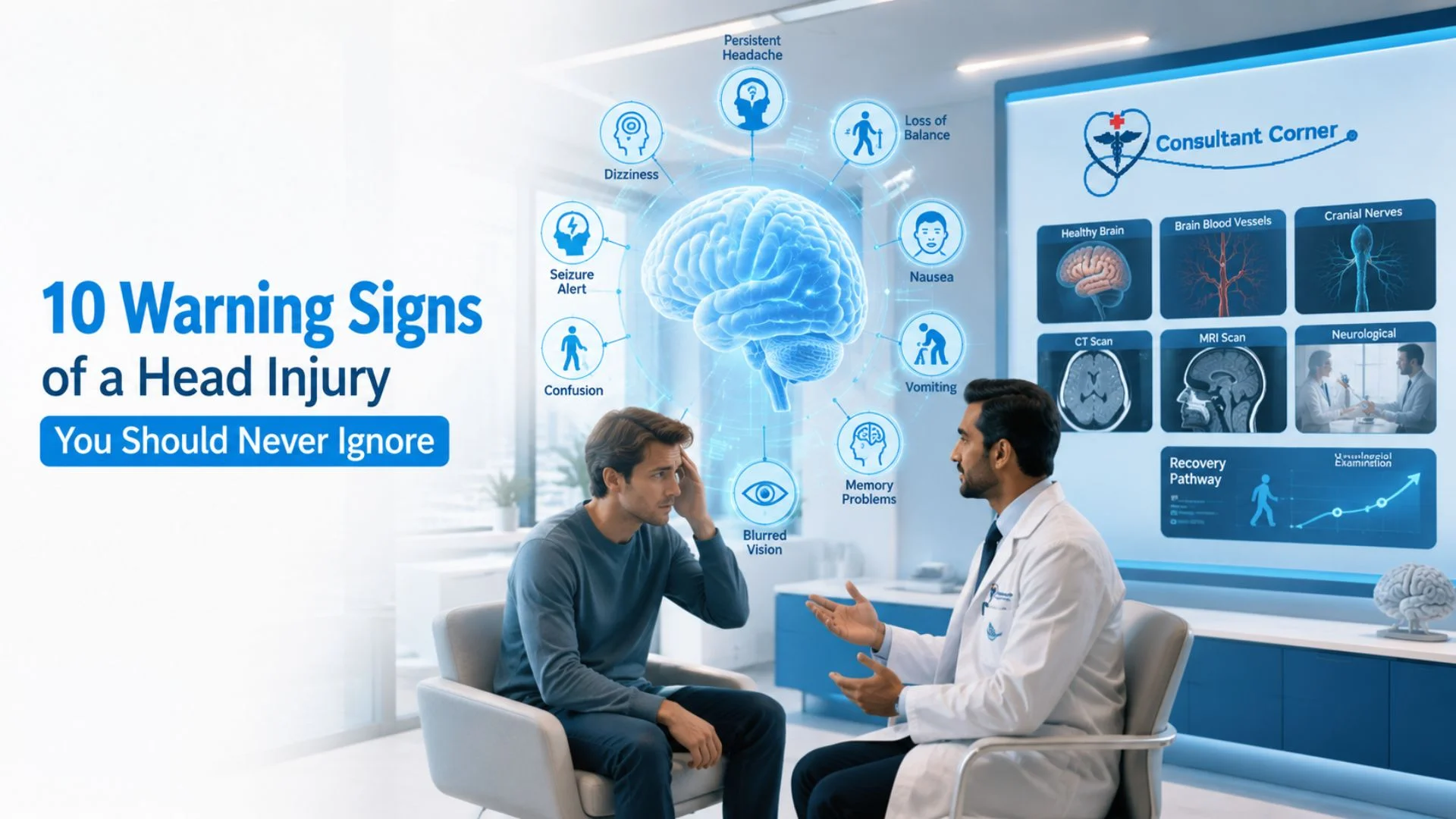
10 Warning Signs of a Head Injury You Should Never Ignore
1. Headaches That Don’t Go Away or Keep Getting Worse
It’s common to have mild pain after a concussion, but if the headache doesn’t go away and instead gets worse within a few hours, that’s one of the most important warning signs on this list. Worsening headaches can indicate pressure inside the skull caused by swelling or bleeding. This is different from a common tension headache, which is usually mild and stable rather than severe.
2. Dizziness, Loss of Balance, or Feeling Unsteady
Having trouble walking straight after a head injury, feeling unsteady on your feet, or generally feeling something unusual or out of place is often a sign that the injury has disrupted the pathways in the brain responsible for coordination and spatial awareness. This can happen right away or develop gradually over the next day.
3. Nausea or Repeated Vomiting
It’s not uncommon to feel nauseous occasionally after a concussion, but persistent nausea — or vomiting repeatedly — is a recognized sign of increased pressure inside the brain and should never be ignored, especially in children and the elderly.
4. Trouble Concentrating, Remembering, or Processing Information
Many people compare this to a “foggy” feeling, mental slowness, or an inability to hold on to a thought after a head injury. Difficulty concentrating at work, forgetting recent conversations, or having trouble following a simple task are some of the common symptoms of a concussion, which require a proper neurological evaluation.
5. Sensitivity to Light or Blurred Vision
Photophobia (sensitivity to light) and vision problems, such as blurred or double vision, can occur immediately after the injury or several days later. These symptoms indicate that the brain is still inflamed from the injury and has not fully healed.
6. Sudden, Severe Headache That You Have Never Had Before
A “thunderclap” headache — which starts suddenly and feels much more severe than any headache you have had before — is different from the gradual onset headaches described above. This type of headache can signal bleeding and requires emergency medical attention.
7. Weakness, Numbness, or Tingling on One Side of the Body
If an arm or leg feels weak, numb, or difficult to control after a head injury, it could indicate pressure on the brain that is affecting its circulation. This symptom should never be observed at home; it requires urgent evaluation.
8. Confusion, Slurred Speech, or Unusual Behavior
This is often noticed by family members or coworkers before the injured person. Slurred speech, disorientation, asking the same questions repeatedly, or unusual behavior after a head injury — these are warning signs of a potentially serious brain injury (traumatic brain injury).
9. Seizures or Convulsions
A seizure after any head injury — even if it seems minor — is always a medical emergency and requires calling 911 immediately.
10. Loss of Consciousness, or Clear Fluid Discharge From the Nose or Ears
Any brief loss of consciousness after any head injury should be evaluated by a doctor. Clear or watery fluid discharge from the nose or ears may indicate a skull fracture and cerebrospinal fluid leak, which requires emergency treatment.

Mild vs. Severe Head Injuries: A Brief Comparison
Not all head injuries require an ambulance, but knowing the difference between symptoms that can wait until pre-arranged treatment and those that require urgent treatment can be life-saving.
| Symptom Category | Mild Head Injuries (See a Neurologist) | Severe Head Injuries (Call 911/Go to the ER) |
|---|---|---|
| Headache | Mild, persistent, relieved by rest | Sudden, severe, or increasing |
| Consciousness | Never lost consciousness | Any loss of consciousness, even for a short time |
| Thinking/Memory | Mild confusion that improves within a few hours | Confusion, disorientation, repeated questioning |
| Balance | Slight wobbling | Inability to walk, severe imbalance |
| Nausea | Mild, resolves quickly | Repeated vomiting |
| Movement | Normal strength and sensation | Weakness or numbness on one side of the body |
| Other | Mild sensitivity to light or sound | Seizures, slurred speech, fluid from the nose/ears |
If you are ever unsure which category applies to you, consider it an emergency. It is always safer to get tested than to wait.
What Can Happen If a Head Injury Is Not Treated
If this type of injury is not properly evaluated, it can lead to complications that are much more serious than the initial injury, including:
- Concussion and post-concussion syndrome — chronic headache, fatigue, and cognitive symptoms that can last for weeks
- Epidural or subdural hematoma — bleeding between the skull and brain that can compress brain tissue
- Skull fractures — which can also cause internal bleeding
- Persistent headaches, memory problems, mood swings, or sleep disturbances that persist for weeks after the original injury
The National Institute of Neurological Disorders and Stroke notes that people who suffer a second head injury before fully recovering from the first injury are at increased risk of permanent brain damage — a phenomenon sometimes called “second impact syndrome.” This is one of the main reasons why doctors recommend a complete evaluation and a gradual return to normal activities under supervision, rather than just a quick self-exam at home.
How a Neurologist Evaluates a Head Injury
When you come to Consultant Corner after this type of injury, your evaluation will typically include:
- A detailed description of the injury — how it happened, whether you lost consciousness, and how your symptoms have changed since then.
- A neurological exam — checking balance, coordination, reflexes, memory, and eye movement.
- A review of any ER records or imaging — if you’ve already had a CT or MRI scan, we explain what the results really mean for your recovery.
- A personalized recovery plan — which includes instructions on rest, a gradual return to work or sports, and treatment of lingering symptoms like headaches or sleep problems.
- Follow-up care — Because symptoms can change after this type of injury, ongoing monitoring is often a part of a safe recovery.
According to the Mayo Clinic, even a mild traumatic brain injury is a serious injury that requires prompt attention and a proper diagnosis — it’s not something that can just be “waited out.”
Meet Your Neurologist
Head injury evaluations at Consultant Corner are conducted by Sakib A. Chowdhury, MD, a fellowship-trained vascular neurologist and neurointensivist. Dr. Chowdhury specializes in the diagnosis and management of traumatic brain injury, concussion, and neurological complications resulting from head trauma, providing patients with a clear and expert path to recovery from their injuries.
Why Patients Trust Consultant Corner After a Head Injury
These types of injuries are scary, especially when the symptoms are unexpected. Patients choose Consultant Corner because we offer:
- Expert neurology evaluation by a physician experienced in treating concussions and brain injuries
- Review of scans and ER reports, along with a clear explanation of what your CT or MRI actually shows
- A personalized treatment plan tailored to your symptoms and lifestyle
- Management of ongoing symptoms, including headaches, dizziness, attention problems, sleep problems, and memory loss
- Same-week appointments, because brain health shouldn’t wait
If you’re suffering from any of these related issues, these articles may also be helpful to you:
- Understanding Ischemic Stroke: Causes, Symptoms, and Treatment
- Headaches vs. Migraines: How to Tell the Difference
- Early Signs of Alzheimer’s Disease Everyone Should Know
You can also learn more about our team and locations, including our Bloomington, Illinois neurology office and our El Paso, Texas health consulting office.
When Should You Go to the ER Immediately for Head Injury Symptoms
Some symptoms after a head injury are true emergencies. If you experience the following symptoms, call 911 or go to the nearest emergency department immediately:
- Loss of consciousness
- Sudden, severe headache
- Repeated vomiting
- Weakness or numbness on one side of the body
- Seizures
- Confusion or unusual behavior
- Clear fluid discharge from the nose or ears
If you are unsure whether your symptoms are serious, it is always safe to get checked out by a doctor.

Head Injury Recovery: What to Expect
Most people recover from a mild head injury within one to two weeks, although symptoms can sometimes last longer. During recovery, doctors usually recommend the following:
- Physical and mental rest for the first 24-48 hours
- Return to work, school, or sports gradually under your doctor’s guidance — do not suddenly return to full normal activity
- Avoid activities that pose a risk of a second head injury until you are fully recovered
- Monitor symptoms and contact a neurologist if headaches, dizziness, or memory problems persist
Frequently Asked Questions About Head Injuries
How do I know if my head injury is serious? Look out for the warning signs above — increasing headache, repeated vomiting, confusion, weakness on one side of the body, seizures, or loss of consciousness. If any of these symptoms occur after a head injury, you should seek emergency medical attention immediately. Even mild symptoms, such as a brief headache or mild confusion, should be evaluated by a neurologist within a few days.
Can symptoms persist for days after the injury? Yes. It is common for symptoms such as headache, dizziness, and lack of concentration to appear or worsen not immediately after the injury, but in the days that follow. This is why doctors recommend monitoring yourself closely for at least a week or two.
Do I need a CT scan or MRI afterward? Not always. Imaging is usually done for worrisome symptoms such as loss of consciousness, severe headache, or weakness in a specific part of the body. A neurologist can help determine whether imaging is needed, based on your specific symptoms and medical history.
When can I return to work or sports after a head injury? The time frame for returning to normal activities varies depending on the individual and the severity of the injury. Most doctors recommend a gradual and step-by-step return to normal activities under the supervision of a healthcare provider — starting with light activities and progressing gradually as symptoms improve.
Should I see a neurologist even if I don’t go to the emergency room? Yes. Many people do not go to the emergency room after this type of injury, but they benefit from a neurological evaluation, especially if symptoms such as headache, dizziness, or trouble concentrating persist for more than a few days.
Are concussions and head injuries the same thing? A concussion is a type of mild traumatic brain injury and is a possible consequence of a head injury. Not every concussion results in a concussion, but every concussion is caused by a blow to the head or a forceful jolt to the body that jolts the head and brain.
Don’t Delay Getting Tested After a Head Injury
If you’ve recently suffered a head injury and something doesn’t feel right, trust your instincts. Your brain is too important to leave to chance, and early assessment is one of the most effective ways to prevent complications and help you make a full recovery.
Consultant Corner is here to help you find clear answers, expert care, and a safe path after an injury like this.
Schedule Your Head Injury Evaluation Today
📞 Book your appointment online or call our office directly. Same-week appointments are available for patients with recent head injuries.