Head Injury Explained: Symptoms, Recovery and Medical Care
Head injuries can happen in the blink of an eye — like a fall in the bathroom, a collision on the street, a hit during sports, or even an accidental bump on a cabinet door. But their effects can spread over days, weeks, or even months of your life. Understanding what a head injury really means, knowing what signs to look out for, what the recovery process is like, and when to call a doctor — can have a profound impact on how fully and quickly you or your loved one recovers.
This detailed guide has everything you need to know about head injuries: their different types, common and emergency warning signs, the full stages of recovery, specific populations at highest risk, how doctors diagnose the condition, and practical steps you can take now to protect your brain health.
What Is a Head Injury?
A head injury is any type of injury to the scalp, skull, or brain. It ranges from a minor injury that causes a small swelling and resolves within a day to a severe traumatic brain injury (TBI) that can affect memory, mood, movement, or consciousness for months or longer.
Not all head injuries directly affect the brain. Because the scalp tissue is rich in blood vessels, a wound can bleed profusely without causing any brain damage. On the other hand, head injuries that may seem minor on the outside can cause serious internal damage to the brain beneath the skull.
Medically, head injuries can be divided into two main categories:
Closed Head Injuries
The skull remains intact, but the brain can be jolted, crushed, or twisted within the skull cavity. The most common type is a concussion, which occurs when the brain moves rapidly within the skull and temporarily disrupts normal brain function. About 75% of all traumatic brain injuries in the United States each year are closed head injuries.
Open (Penetrating) Head Injuries
An object penetrates the skull and can directly damage brain tissue. These are usually more serious, almost always require emergency surgery, and carry a significantly higher risk of permanent neurological damage.
Within both categories, head injuries are further classified by their severity — mild, moderate, or severe — depending on whether the person lost consciousness, how long the confusion lasted, and what is seen on brain imaging.
How Common Are Head Injuries?
Head injuries are much more common than most people realize. According to the Centers for Disease Control and Prevention (CDC), about 1.7 million traumatic brain injuries occur in the United States each year, with about 3% of cases resulting in death. Adults are most commonly affected, although children and the elderly also have their own increased risks that warrant special attention.
Common Causes of Head Injuries
The cause of a head injury often determines the type and severity of subsequent damage. Understanding its mechanisms is important, because high-energy trauma — such as a motor vehicle accident or a fall from a height — greatly increases the likelihood of serious brain injury, even when the initial symptoms seem mild.
The most common causes include:
- Falls — The leading cause of head injury overall is falls, especially in young children and adults over 65. Imbalance, changes in vision, and medications that impair coordination all significantly increase the risk of falls in older adults.
- Motor vehicle accidents — More serious injuries tend to be caused by the force of a vehicle collision. Even if there is no direct blow to the head, whiplash-like movements can cause the brain to hit the inside of the skull.
- Sports-related injuries — Concussions are common in contact sports such as football, soccer, rugby, hockey, and boxing. Even cycling and skiing without a properly fitted helmet pose a significant risk of head injury.
- Workplace accidents — Construction and industrial workers face a high risk of injuries from falling objects, falls from elevated platforms, or equipment-related injuries.
- Physical assaults — Blunt force trauma to the head during assaults accounts for a significant portion of head injury-related visits to emergency departments each year.

Head Injury Symptoms: What to Look Out For
One of the most important things to understand about head injuries is that symptoms don’t always appear immediately. They can appear hours — sometimes even a day or two — after the initial injury. Because of this delayed onset, anyone who has suffered a head injury should be monitored closely for at least 24 to 48 hours, even if they feel completely fine immediately after the event.
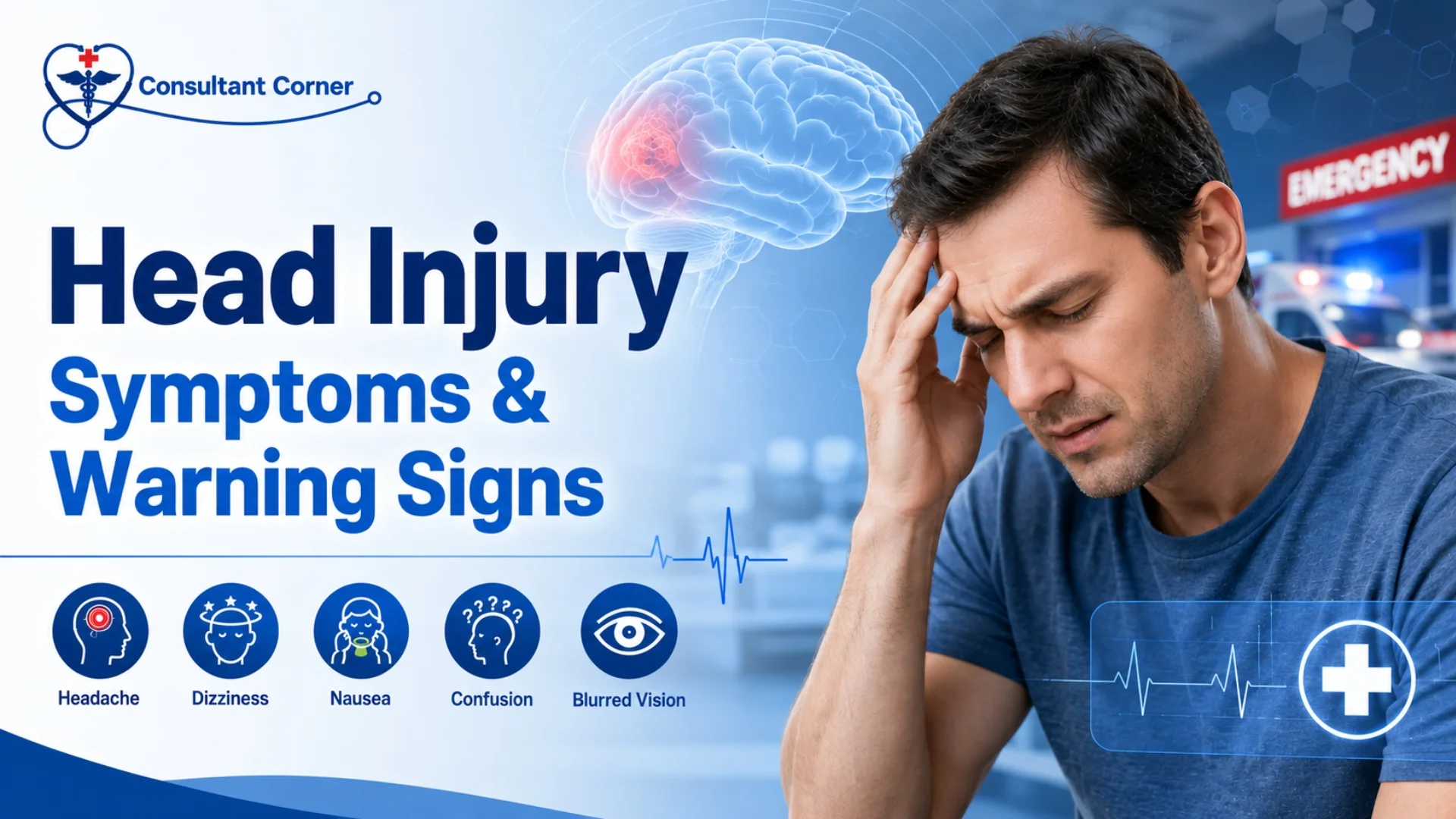
Common Symptoms of Head Trauma
- Persistent or worsening headache
- Dizziness or problems with balance and coordination
- Nausea or vomiting
- Confusion, mental fog, or difficulty concentrating
- Memory problems, especially difficulty remembering the event of the injury (post-traumatic amnesia)
- Sensitivity to light (photophobia) or sensitivity to sound (phonophobia)
- Unusual tiredness or drowsiness
- Irritability, mood swings, or excessive anxiety
- Ringing in the ears (tinnitus) or blurred vision
- Sleep disturbances — either difficulty falling asleep easily or sleeping much more than usual
These symptoms are quite similar to other neurological disorders. For example, persistent headaches after a head injury can feel like migraines. If you have recurring headaches, check out our related guide — Can Bad Posture Cause Headaches? Causes, Symptoms, and Treatment — to learn how different physical conditions can cause similar symptoms.
Emergency Warning Signs After a Head Injury
While many symptoms of a head injury can be managed with rest and careful observation at home, some symptoms require immediate emergency medical attention. Swelling and internal bleeding can occur in the brain without any visible external injury, and these conditions can quickly become life-threatening.
Call 911 or Go to the Emergency Department Immediately If:
- The headache gets worse rather than better
- Repeated or violent vomiting (more than once or twice)
- The person becomes slurred or has difficulty finding words
- Seizures or convulsions occur
- One eye is noticeably larger than the other (asymmetrical pupils)
- The person experiences confusion, extreme disorientation, or a dramatic change in behavior
- Loss of consciousness for even a short time
- Weakness or numbness in one or more limbs
- Clear fluid or blood coming out of the nose or ears (a possible sign of a basilar skull fracture)
- The person falls asleep after the injury and cannot be awakened
These warning signs indicate potentially life-threatening complications — such as epidural hematoma, subdural hematoma, or massive brain swelling — all of which require prompt neurosurgical evaluation. If these symptoms appear, don’t wait to see if “it gets better on its own.” Every minute counts.

Head Injuries in Special Populations
The risk of head injuries is not the same for everyone. Two groups in particular require extra caution and attention.
Head Injuries in Children
Children’s brains are still actively developing, which means they react differently to injuries than adults. Young children often cannot clearly describe their feelings, so caregivers must watch for behavioral signs, such as excessive or inconsolable crying, unusual sleepiness, refusal to eat or drink, vomiting, or loss of newly acquired skills such as walking or talking. Any loss of consciousness in a child, no matter how brief, should prompt medical attention.
Head Injuries in the Elderly
Although relatively minor injuries are common, the elderly are at particularly high risk of serious complications. Several factors combine to increase this risk:
- Many older people take blood-thinning medications (anticoagulants or antiplatelets) for heart disease. These medications can also allow small internal bleeding to run unchecked, creating dangerous hematomas.
- Normal age-related brain degeneration creates spaces between the brain and the skull. This means that the brain can move more as a result of an injury, which can stretch the connecting veins and increase the risk of a subdural hematoma — sometimes without any obvious symptoms until days after the event.
- Imbalance, vision loss, and medication side effects all increase the likelihood of a fall in the first place.
For families caring for an elderly parent or relative, it is essential to be alert to subtle changes in cognition, balance, or behavior after any fall — even a seemingly minor one.
Athletes and Repeated Head Injuries
Athletes who participate in contact sports face an increased risk that is especially worth mentioning. Each concussion, even a mild one, can increase the risk of more serious symptoms in a subsequent injury. When a second concussion occurs before the first one has fully recovered, it is sometimes called “second impact syndrome.” Any athlete with a concussion should get a doctor’s clearance before returning to play — a guideline supported by every major sports medicine organization around the world. According to the American Academy of Neurology, no athlete should return to play or practice the same day a concussion is suspected.
People on Blood Thinners
People taking warfarin, rivaroxaban, apixaban, clopidogrel, or similar medications should seek medical attention immediately after any head injury, even when symptoms seem mild. The risk of bleeding is significantly increased, and what appears to be a small amount of swelling on the surface may be hiding dangerous bleeding inside the brain.
How Doctors Diagnose a Head Injury
When a patient comes to a neurologist or emergency room doctor after a head injury, the evaluation usually includes several components:
- A detailed history — The doctor will ask specifically about how the injury occurred, whether there was loss of consciousness, how long the confusion lasted, and what symptoms occurred in the hours following the event.
- Neurological examination — This evaluates reflexes, eye movements, pupillary responses, coordination, balance, and basic motor skills. Abnormalities here may indicate more serious structural injuries beneath the surface.
- Cognitive screening — Tests of attention, short-term memory, working memory, and processing speed help identify the functional impact of the injury on brain function.
- Brain imaging — Imaging is not necessary for all types of head injuries. A CT scan is usually ordered if there is concern about bleeding, fractures, or serious structural injuries. An MRI may be used later for a more detailed structural evaluation or if the CT scan results are unclear. Many mild concussions are diagnosed based on symptoms and clinical exam results alone.
- Standardized concussion tools — Tools like the SCAT (Sport Concussion Assessment Tool) or ImPACT tests can be used to establish baseline comparisons in sports and monitor recovery progress.
If you experience symptoms including vision changes after a head injury, our related post, What Is an Ocular Migraine? Vision Changes and Types of Migraines, explains how head injuries can cause some visual disturbances that need to be properly differentiated from other conditions.
Recovering from a Head Injury: What to Expect
Recovery from a head injury varies greatly from person to person. The severity of the injury, the person’s age, their pre-existing health conditions, and whether they have had previous head injuries all play a role in determining the recovery process. A mild concussion can usually heal in one to two weeks with proper rest and management. Moderate to severe injuries may require months of well-organized, multidisciplinary rehabilitation.
Stages of Recovery from a Head Injury
Acute Phase (First 24–72 hours)
This is the most critical time to monitor. During this time, symptoms can change rapidly, for better or worse. Physical and mental rest is essential. Screen time, reading, bright light, and physical exertion should all be minimized as much as possible. This is when emergency symptoms, if they occur, are most likely to manifest.
Early Recovery (A Few Days to 2 Weeks)
For most people with mild head injuries, headaches, fatigue, and problems with concentration gradually begin to subside. Daily activities are resumed slowly and gradually. Contact sports and any activities that carry a risk of a second head injury should be avoided until fully cleared by a doctor.
Extended Recovery Period (Weeks to Months)
For moderate or severe injuries — or those who return to normal activities too quickly — some symptoms, especially cognitive symptoms such as memory problems, attention problems, or emotional imbalance, may last significantly longer. In this case, structured rehabilitation under the supervision of a neurologist, neuropsychologist, physical therapist, or occupational therapist may be necessary.
Practical Tips for Recovering from a Head Injury
- Rest both your body and mind for the first 24 to 48 hours — limit not only physical activity, but also screen time, reading, and stressful tasks.
- Avoid alcohol, which can mask warning signs and delay the healing process.
- Prioritize regular, adequate sleep — the brain heals most efficiently during deep sleep.
- Drink plenty of water and eat nutritious foods regularly to aid in neurological recovery.
- Keep a daily log of your symptoms and report any symptoms that get worse rather than better.
- Avoid driving until you have the OK from your doctor, especially if you have dizziness or trouble concentrating.
- Do not return to contact sports or physical activity without your doctor’s express permission.
If you have persistent symptoms several weeks after your head injury — especially persistent headaches, dizziness, difficulty concentrating, or mood swings — this is a signal to seek professional evaluation rather than waiting. Post-concussion syndrome is a real, recognized medical condition that responds well to specific, individualized treatment. You can also read our blog, Is a Migraine a Legitimate Reason to Skip a Meeting? What You Need to Know, to understand how post-traumatic headaches can significantly interfere with daily activities and what measures may be appropriate.
When to Seek Treatment for a Head Injury
A practical rule of thumb is: if you are not sure whether a head injury is serious, treat it as serious. It is unlikely that getting an evaluation to make sure everything is okay will do any harm. But failing to recognize early signs of bleeding or swelling inside the brain can be life-changing.
Seek medical attention for a head injury when:
- You have lost consciousness, no matter how brief.
- Symptoms worsen rather than improve within the first 24 to 72 hours.
- The person is confused, has slurred speech, or shows unusual behavior.
- The injury was caused by a forceful blow — such as a car accident, a fall from a height, or a high-speed collision during sports.
- The person is taking blood thinners or has a known bleeding problem.
- The person is a young child or elderly person.
- The headache is described as “the worst headache of my life” — a phrase that sometimes indicates bleeding around the brain.
- Any of the emergency warning signs listed above are present.
For those who are unsure whether their symptoms require urgent immediate testing or can be safely monitored at home, a telehealth neurology consultation can be a valuable first step, ensuring expert guidance and saving time.
Preventing Head Injuries: Evidence-Based Effective Steps
While no strategy can completely eliminate the risk of head injuries, several evidence-based measures significantly reduce them:
- Wear a properly fitted helmet when cycling, skiing, skating, and playing contact sports. According to research published in the American Journal of Surgery, helmets reduce the risk of serious head injuries in cyclists by up to 85%.
- Use seatbelts on every ride and make sure children are properly restrained in age-appropriate car seats.
- Make your home fall-proof for seniors — secure loose carpets, install grab bars in bathrooms, improve lighting in stairs and hallways, and eliminate tripping hazards.
- Address risk factors for falls — review medications for side effects such as dizziness, treat vision problems, and consider formal exercises to improve balance.
- Follow the return-to-play guidelines before resuming contact sports after any concussion or head injury.
- Avoid alcohol before activities that involve a risk of falling or collision.
Frequently Asked Questions About Head Injuries
How do I know the difference between a minor bump and a serious head injury?
A minor bump usually causes short-term pain in a specific area and perhaps a small amount of swelling that goes away in a day or two. In the case of a serious head injury, symptoms tend to get worse over time instead of getting better — such as severe headaches, repeated vomiting, confusion, slurred speech, or excessive sleepiness. When symptoms get worse instead of better, seek medical attention without delay.
Is it normal to feel better right after a head injury and then feel worse later?
Yes, and this is one of the most important things to understand about head injuries. Some injuries — especially those that involve internal bleeding or swelling — can take hours or even days to show noticeable symptoms. For this reason, anyone who has suffered a head injury should be monitored for at least 24 to 48 hours, even if they feel completely fine immediately after the incident.
Can I sleep after a head injury?
Sleep is important for brain recovery and is generally safe after a minor head injury. However, during the first night after a serious injury, it is reasonable to monitor the person periodically to make sure they are waking up normally and are not developing any new symptoms. The old advice that “no one should sleep after a concussion” is not medically supported for minor injuries — the important thing is to keep the person rousable and make sure their condition isn’t worsening.
How long does it take to recover from a concussion?
Most mild concussions resolve within one to two weeks with proper rest and a gradual, step-by-step return to normal activities. If the person returns to normal activities too quickly, has a previous head injury, or has an underlying medical condition such as anxiety or a pre-existing headache disorder, recovery may take longer.
When should you go to the emergency department for a head injury?
If a head injury causes loss of consciousness, repeated vomiting, seizures, unequal pupils, slurred speech, increasing confusion, weakness or numbness in the arms or legs, or any fluid or blood coming out of the nose or ears, go to the emergency department immediately. For mild, non-worsening symptoms, a same-day telehealth or clinic consultation is a reasonable first step.
Can head injuries cause long-term problems?
In most mild cases, people make a full recovery. However, repeated head injuries, more severe injuries, or insufficient recovery time can sometimes cause lasting problems with memory, attention, mood regulation, balance, or sleep. For this reason, follow-up care with a neurologist is recommended if symptoms persist beyond the expected recovery period.
Should every child with a head injury see a doctor?
In general, it is wise to have any head injury in young children — especially those accompanied by loss of consciousness, vomiting, behavioral changes, or unusual sleepiness — evaluated by a medical professional. Young children cannot always clearly express their feelings, so clinical evaluation is especially important for children in this age group.
Does a normal CT scan mean the head injury wasn’t serious?
A normal CT scan can rule out important factors such as severe bleeding, major bruising, and skull fractures — but it does not provide a complete picture of how a concussion affects brain function. If symptoms persist after a normal CT scan, follow-up evaluation is necessary and should not be ignored just because the imaging is clear.
Talk to a Neurologist About Your Head Injury Today
If you or someone you know has suffered a head injury and have questions about symptoms, recovery, or whether specialist care is needed, contact us to schedule a consultation.