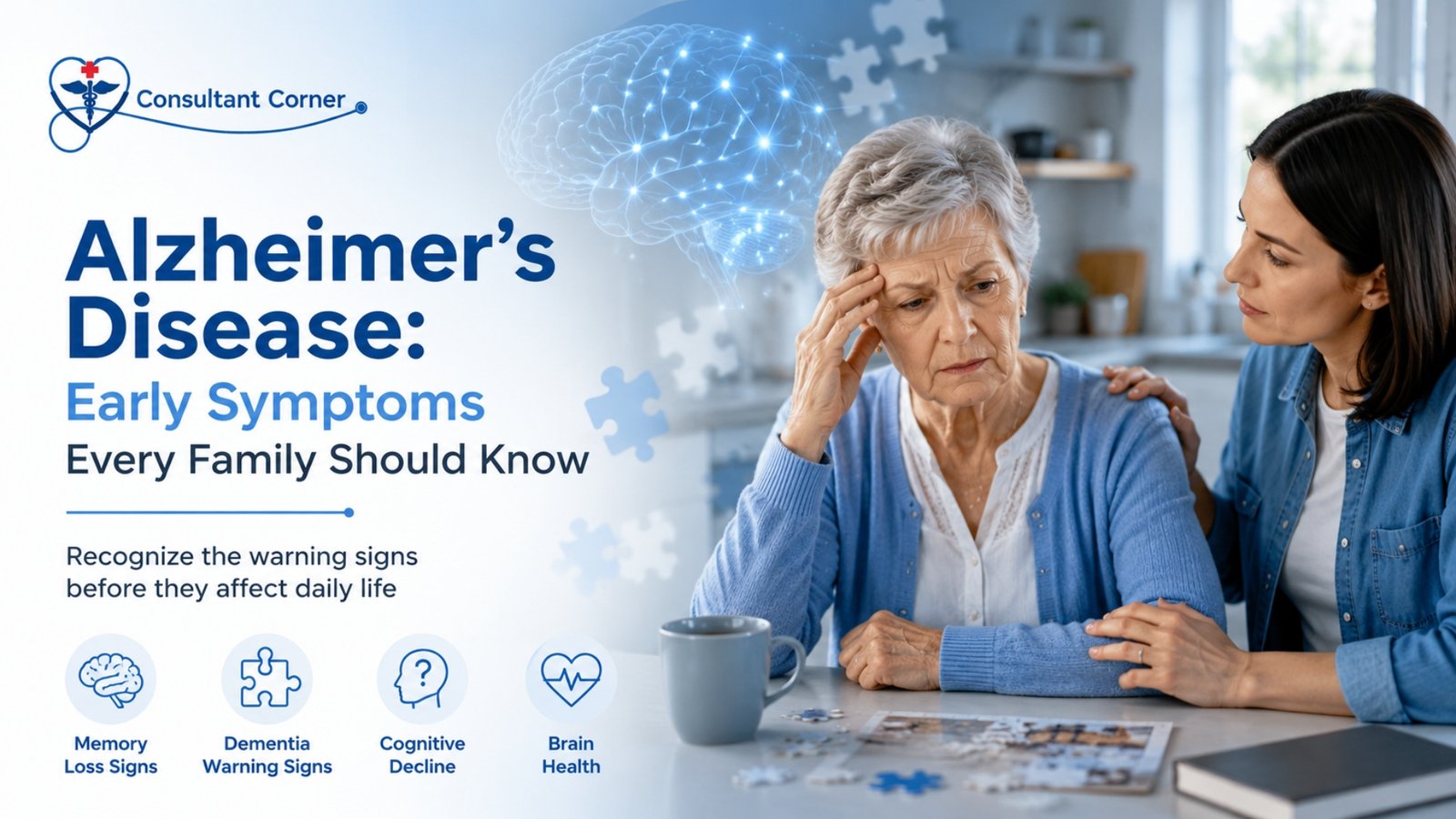
Alzheimer’s Disease: Early Symptoms Every Family Should Know
Recognizing the early signs of Alzheimer’s disease can make the difference between a family being caught off guard and a family being prepared with a plan. Memory loss is often dismissed as “a normal part of aging,” but when this forgetfulness begins to interfere with conversations, meetings, familiar daily tasks, or personal safety, it can be one of the earliest warning signs of Alzheimer’s disease or a related condition. The disease is more common in certain age groups and its severity often depends on a person’s overall health — a pattern that is consistent across the United States, where Alzheimer’s disease remains the leading cause of memory loss in older adults.
This guide discusses the early signs of Alzheimer’s disease that every family should watch for, conditions that can mimic memory loss, why early diagnosis is so important, and how a neurology team like Consultant Corner can help you get a clear picture instead of guessing.
Is Forgetfulness Starting to Affect Your Daily Life?
Occasional forgetfulness — like misplacing keys or momentarily forgetting a name — is normal. But when memory loss starts to interfere with daily activities, relationships, or independence, it’s time to pay closer attention. What seems like “normal aging” may actually be the early signs of Alzheimer’s disease, mild cognitive impairment (MCI), or a completely different neurological disorder.
The earlier these changes are assessed, the more options families have. Early assessment can slow physical decline, preserve independence, and give families the clarity they need to plan for the future with confidence. If you’re also noticing changes in mood or sleep along with memory problems, check out our article on Sleep and Brain Health: What’s the Connection?, which explains how insufficient sleep can accelerate cognitive symptoms.

Danger Signals You Should Never Ignore
Understanding the early signs of Alzheimer’s disease means knowing what falls outside the normal range of aging. If you notice any of the following symptoms, a neurological evaluation is recommended.
Memory Changes
- Forgetting recent events or conversations shortly after they occur
- Misplacing things in unusual places and not being able to remember previous steps to find them
- Relying heavily on notes, reminders, or family members to recall information that was previously easy to remember
Thinking and Communication Problems
- Having trouble finding the right words during conversations
- Repeating the same questions over and over again in a short period of time
- Having trouble following conversations, especially in groups or in noisy environments
Impairment in Daily Activities
- Having trouble managing bills, medications, or appointments that were previously easy to manage
- Getting lost in familiar places, even in neighborhoods you’ve lived in for years
Changes in Behavior or Mood
- Irritability, anxiety, depression, or social isolation
- Suspicion, unreasonable suspiciousness, or unusual decision-making
These early warning signs are often a sign of an underlying illness, and it can take months or even years before a diagnosis is made. That’s why the early signs of Alzheimer’s disease can be easy to miss — they don’t appear all at once, but develop gradually.
Why Subtle Signs Matter
Missing a single appointment isn’t a warning sign. But missing appointments, asking the same questions over and over again over several months, and having difficulty with daily activities are. Paying attention to these symptoms as a pattern rather than isolated events is one of the most helpful things a family can do before they see a doctor.
Memory Loss Doesn’t Always Mean Alzheimer’s
One of the most important things to understand is that the early signs of Alzheimer’s disease can overlap significantly with the symptoms of other, sometimes treatable, diseases. There are many causes of memory loss, and the job of a neurological evaluation is to find the real cause behind the symptoms — not just assume the worst.
Common Causes We Evaluate
| Possible Cause | Common Symptoms | Is It Curable? |
|---|---|---|
| Alzheimer’s disease | Gradual memory loss, confusion, language difficulties | Manageable, not curable |
| Mild cognitive impairment (MCI) | Noticeable changes in memory, daily activities mostly intact | Sometimes reversible |
| Vitamin B12/folate deficiency | Fatigue, confusion, amnesia | Yes, often fully treatable |
| Thyroid problems | Brain fog, mood swings, slow thinking | Yes, with medication |
| Depression and anxiety | Forgetfulness, lack of focus, lack of motivation | Yes |
| Sleep problems (including apnea) | Daytime confusion, difficulty remembering | Yes |
| Medication side effects | Sudden confusion or memory problems | Yes, often reversible |
| Mini-stroke (TIA) or vascular dementia | Sudden memory lapses, weakness in a specific area | Partially treatable |
| Past concussions or head injuries | Memory and attention problems | Varies depending on severity |
Treatment is much more effective when the cause is identified early, which may mean addressing vitamin deficiencies or starting a long-term care plan for Alzheimer’s disease. To learn more about the relationship between memory and vascular health, see our post on Understanding TIAs and Mini-Strokes.
Why Early Diagnosis Is Important
Identifying the early signs of Alzheimer’s disease as early as possible can change the entire course of treatment. Taking action early means:
- Better control of symptoms through specific treatments
- Slow cognitive decline in many cases
- Safety in daily activities and reduced risk of falls or wandering around aimlessly
- More time to plan and prepare legally, financially and emotionally
- More effective medication, as many treatments for Alzheimer’s work best in the early stages
- Stronger support for carers and family members, who often bear the most stress
On the other hand, waiting can mean a rapid deterioration of the condition and fewer treatment options before symptoms are identified. If your loved one has recently been diagnosed, our Supporting a Family Member with a New Diagnosis guide for carers outlines some practical next steps.
Why Families Trust Consultant Corner
Consultant Corner provides comprehensive, compassionate, and expert care based on a thorough and personalized process for early signs of memory loss and Alzheimer’s disease.
Complete Neurological Assessment
A detailed review of symptoms, medications, mood, sleep, and risk factors provides our team with a complete picture before reaching a decision.
Cognitive Testing
Quick and effective in-office testing helps accurately diagnose both the type and severity of memory changes, helping to differentiate between normal aging problems and problems that require close attention.
Review of CT/MRI Brain Scans
When imaging is available or needed, we clearly interpret changes and identify symptoms consistent with Alzheimer’s disease, previous stroke, or other underlying causes.
Personalized Treatment and Care Plans
Each plan is tailored to the individual, combining medications, lifestyle changes, memory strategies, and home safety guidelines.
Support for Families and Caregivers
Education, information, and step-by-step recommendations help families feel less alone in the process.
Same-Week Appointments
Because memory problems shouldn’t take months to resolve, we prioritize the opportunity to get treatment in a timely manner.
When Memory Loss Is an Emergency
While most early symptoms of Alzheimer’s disease develop gradually, some memory or cognitive changes signal a true emergency. If the following symptoms suddenly occur along with memory changes, call 911 or go to the nearest emergency department:
- Sudden confusion
- Weakness or numbness on one side of the body
- Difficulty speaking or slurred speech
- Sudden vision changes
- A severe headache you’ve never had before
- Loss of consciousness
- Sudden, unusual behavioral changes
These symptoms may be signs of a stroke or other acute neurological emergency and require immediate medical attention — not a scheduled evaluation.
For general information about Alzheimer’s research and statistics, the Alzheimer’s Association provides up-to-date and reliable resources for families following a new diagnosis.

Frequently Asked Questions
What are the early signs of Alzheimer’s disease to look out for? Early signs typically include forgetting recent conversations, asking the same questions over and over again, misplacing items, and difficulty managing everyday tasks like bills or medications.
At what age does Alzheimer’s disease typically begin? Alzheimer’s disease most commonly affects adults over the age of 65, although it can also begin at a younger age in people in their 40s and 50s. The risk increases significantly with age and with certain underlying health conditions.
Is memory loss curable? Some causes of memory loss — such as vitamin deficiencies, thyroid problems, depression, and side effects of certain medications — are treatable or even curable. This is why a thorough evaluation is essential before a diagnosis can be made.
How is Alzheimer’s disease diagnosed? Diagnosis usually involves a detailed history of symptoms, cognitive testing, and often brain imaging, such as a CT or MRI scan, to rule out other causes and evaluate for symptoms consistent with Alzheimer’s.
Is forgetfulness always a sign of Alzheimer’s? No. Occasional forgetfulness is a normal part of aging. The early signs of Alzheimer’s disease are not isolated events, but rather a pattern of progressive decline in memory and functioning over time.
When should a family have a neurological evaluation? If memory or behavior changes are affecting daily life, safety, or relationships, now is the time to schedule an evaluation rather than waiting for symptoms to get worse.
Schedule an Appointment for Your Memory or Alzheimer’s Evaluation
If something seems out of the ordinary, trust your instincts. You don’t have to walk this path alone. Our team helps families find answers, create a plan, and protect the long-term brain health of their loved ones.
👉 Book your appointment today — request an online consultation