

7 Common Lifestyle Factors That May Be Making Your Headaches Worse
Lifestyle Factors that may be making your headaches worse are worth understanding if headaches or migraine attacks repeatedly interfere with your work, family time, sleep, exercise, or normal daily activities.
For people living in Bloomington, Illinois, and El Paso, Texas, a typical day can involve work pressure, commuting, long periods in front of screens, irregular meals, caffeine, insufficient water, limited physical activity, and inconsistent sleep. Each of these habits sits on the list of Lifestyle Factors that headache specialists ask patients to look at first.
But when headaches keep returning, it is important to avoid a common mistake: assuming that one food, one stressful day, or one bad night’s sleep is always the cause.
Migraine is a neurological disease. Lifestyle Factors such as changes in sleep, irregular meals, unmanaged stress, or changes in exercise may influence migraine attacks in susceptible individuals, but they are not the underlying cause of migraine itself.
Understanding this difference can help people make healthier decisions without blaming themselves for their symptoms. If you are also curious about a targeted treatment option, our companion guide, BOTOX Chronic Migraine: 7 Facts Before Your First Injection, walks through what to expect before your first injection.
How Big Is the Neurological Health Problem?
Neurological conditions represent an enormous public-health challenge.
A major Global Burden of Disease 2021 analysis published in The Lancet Neurology estimated that roughly 3.4 billion people — about 43% of the global population — were living with a condition affecting the nervous system in 2021. The same analysis ranked these conditions collectively as the leading group cause of disability-adjusted life years worldwide, ahead of cardiovascular disease.
| Neurological Health Measure | 2021 Estimate |
|---|---|
| People affected globally | 3.40 billion |
| Share of global population | 43.1% |
| Neurological DALYs | 443 million |
| Deaths attributed to nervous-system conditions | 11.1 million |
Source: Global Burden of Disease Study 2021, The Lancet Neurology.
Headache disorders are an important part of this neurological burden. But numbers alone do not tell someone experiencing headaches what to do tomorrow morning — that is where daily habits, and the Lifestyle Factors behind them, become important.
The Lifestyle–Headache Connection: Think About the Whole Day
Imagine this routine: you sleep five hours, wake up late, skip breakfast, drink two cups of coffee, sit at a computer for four hours, delay lunch, drink very little water, and work becomes stressful. By late afternoon, a headache develops.
Was it the coffee? The missed breakfast? The poor sleep? Stress? Dehydration? Hours of inactivity? Or was a migraine attack already developing?
It may be impossible to identify one factor. The American Migraine Foundation recommends looking at migraine management through a broader framework called SEEDS: Sleep, Exercise, Eat, Diary, and Stress.
| SEEDS | What It Means | Daily Goal |
|---|---|---|
| S | Sleep | Maintain a consistent routine |
| E | Exercise | Stay regularly active |
| E | Eat | Eat regularly and stay hydrated |
| D | Diary | Track headache patterns |
| S | Stress | Develop ways to manage stress |
Instead of obsessing over one possible trigger, this approach encourages people to look at their overall routine — and at each of the Lifestyle Factors that make up that routine.

1. Irregular Eating May Be Working Against You
Food is one of the most misunderstood subjects in headache management. Search online for “migraine foods to avoid,” and you may find enormous lists telling you to stop eating chocolate, cheese, processed meat, artificial sweeteners, certain fruits, caffeine, and dozens of other foods.
That approach can be misleading. Potential food-related migraine triggers vary considerably between individuals, and the American Migraine Foundation’s dietary guidance recommends tracking food intake and headaches rather than assuming that every commonly reported trigger applies to every patient.
A more useful first question is: are you eating regularly?
| Habit | Why It May Matter | Better Approach |
|---|---|---|
| Frequently skipping breakfast | Creates long gaps between meals | Develop a regular eating schedule |
| Working through lunch | Makes eating patterns unpredictable | Plan meals around work |
| Extreme elimination diets | Can unnecessarily restrict nutrition | Discuss major dietary changes professionally |
| Assuming every food is a trigger | Triggers vary by individual | Keep a food/headache diary |
| Irregular caffeine intake | Changes may influence headaches | Track intake and keep it consistent |
A balanced approach is generally more useful than fear-based food restriction. Regular meals containing protein, fiber, fruits, vegetables, whole grains, and healthy fats can support general health. If you suspect a particular food, record what you ate, when you ate it, when the headache began, and whether the same pattern occurs repeatedly. A single headache after eating chocolate does not prove that chocolate caused it.

2. Poor Hydration Can Become an Everyday Problem
Many people do not intentionally avoid water — they simply forget. A morning meeting becomes a lunchtime deadline. Lunch becomes another meeting. Then comes driving, picking up children, shopping, exercise, or household responsibilities. Suddenly it is evening.
For people with migraine, maintaining hydration is part of recommended lifestyle management, and it deserves particular attention during exercise, outdoor activity, travel, illness, or hot weather.
| Situation | Ask Yourself |
|---|---|
| Morning | Have I started the day with appropriate fluids? |
| Work | Am I going several hours without drinking? |
| Exercise | Have I considered hydration around activity? |
| Travel | Am I changing my normal drinking routine? |
| Hot conditions | Do I need to pay more attention to fluids? |
The solution is not to consume excessive amounts of water. Fluid needs differ between individuals, and people with heart disease, kidney disease, or medical fluid restrictions should follow individualized medical advice. The goal is appropriate, consistent hydration.
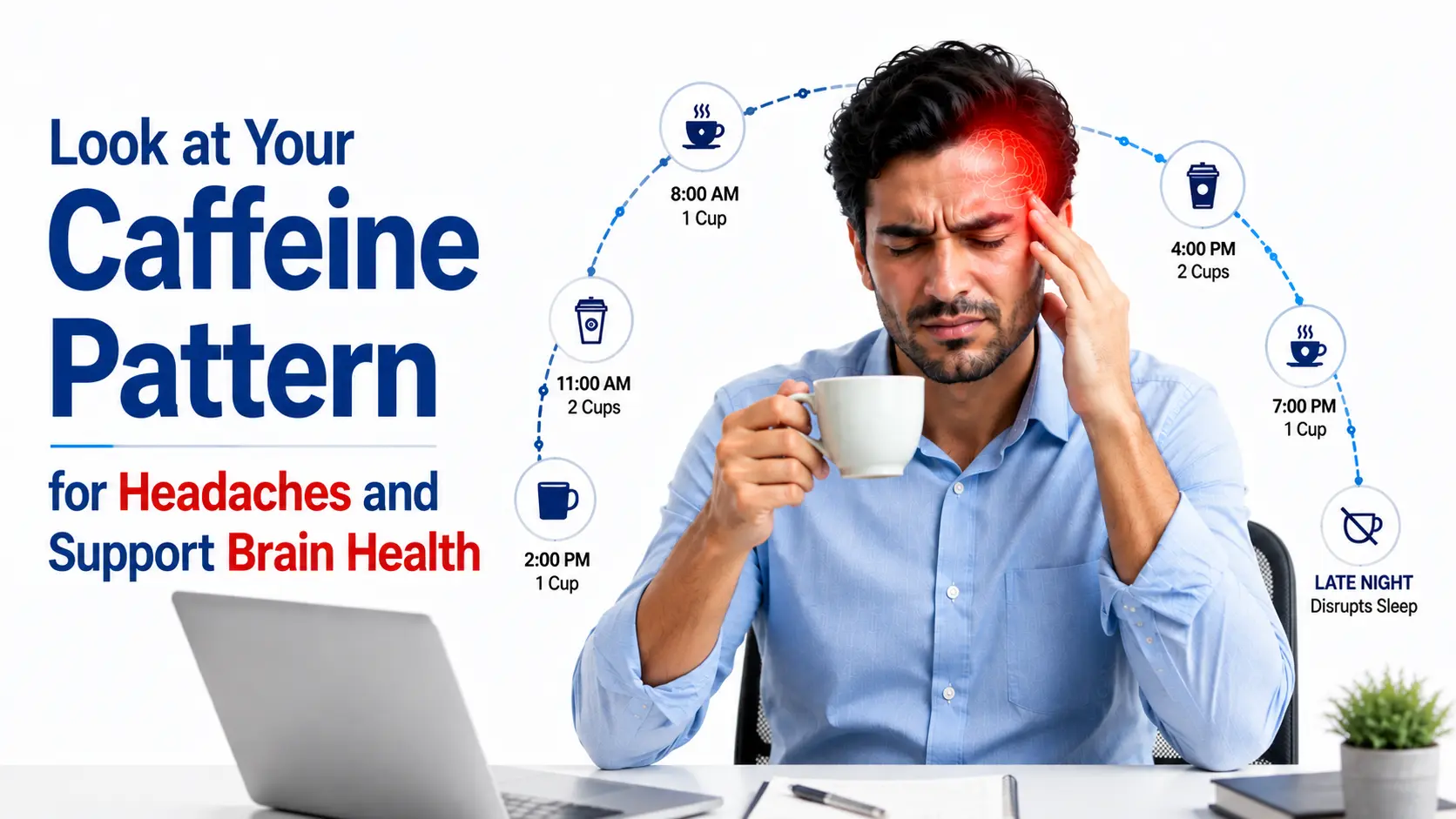
3. Your Caffeine Routine May Matter More Than One Cup of Coffee
Caffeine is complicated. Some people immediately assume that anyone with migraine should stop drinking coffee — that is too simplistic.
Caffeine withdrawal is among the commonly reported dietary factors associated with migraine attacks, while caffeine can also be part of some headache treatments. The more useful question is: how much caffeine do you consume, and how consistent is your consumption?
If headaches frequently occur on weekends, changes in caffeine may be one factor worth recording alongside sleep and meal changes — but don’t assume it is the only factor. Know where your caffeine comes from, since tea, soda, energy drinks, supplements, and some medications can also contain caffeine, and avoid dramatic changes without paying attention to how your body responds.

4. Poor or Irregular Sleep Can Affect Migraine Patterns
Sleep deserves far more attention than it usually receives. Migraine attacks can interfere with sleep, and inadequate or inconsistent sleep may also contribute to attacks in susceptible individuals — a relationship that can become a cycle.
The American Migraine Foundation places Sleep first in its SEEDS framework and recommends maintaining consistent sleep and wake times.
Sleep is not simply about the number of hours — consistency matters too. If you sleep very little during the week and dramatically change your schedule every weekend, your routine may become difficult for a migraine-sensitive nervous system. Try establishing a predictable bedtime, reducing unnecessary stimulation before sleep, and creating a comfortable sleep environment. Regularly waking exhausted, experiencing severe daytime sleepiness, or having other ongoing sleep symptoms may deserve professional evaluation.

5. Too Little Exercise — or Too Much, Too Quickly — Can Be a Problem
Exercise is one of the most useful health habits because its benefits extend far beyond headaches. Regular physical activity supports cardiovascular health, mood, sleep, physical fitness, and stress management.
According to the American Migraine Foundation’s exercise guidance, the research-supported target is approximately 30–50 minutes of moderate-intensity aerobic activity, usually a few times per week, with a gradual, individualized start for anyone who has been inactive.
| Activity | Potential Benefit | Important Consideration |
|---|---|---|
| Walking | Accessible aerobic activity | Start gradually |
| Swimming | Cardiovascular activity | Choose appropriate intensity |
| Cycling | Builds aerobic fitness | Increase duration gradually |
| Yoga | Movement plus relaxation | Adapt to physical ability |
| Jogging | Aerobic exercise | Avoid sudden overexertion |
Some people may experience headache or worsening migraine symptoms during strenuous physical activity. That does not mean exercise is unhealthy — it means exercise should be individualized. If you have been inactive for months, don’t suddenly attempt an intense workout. Start small, build gradually, pay attention to hydration and nutrition, and if exercise causes a new, sudden, or unusually severe headache, particularly with neurological symptoms, seek medical advice.

6. Unmanaged Stress Can Affect Your Entire Routine
Stress does more than make someone feel emotionally uncomfortable — it can disrupt the entire day. Stress may cause you to sleep poorly. Poor sleep may cause you to wake late. Waking late may cause you to skip breakfast. Then you may consume more caffeine, sit at your desk without breaks, and forget to drink water. By evening, several Lifestyle Factors have accumulated at once.
Stress is one of the five components of the SEEDS framework because it is a commonly recognized migraine trigger. Instead of a vague goal like “reduce stress,” identify what stress changes in your routine: Can you protect your lunch break? Maintain your normal bedtime? Take a short walk? Schedule breaks during a long workday? Use breathing, relaxation, mindfulness, or another evidence-informed strategy? Small changes tend to be more sustainable than trying to eliminate stress entirely.

7. Ignoring Other Health Problems Can Put Brain Health at Risk
Not every neurological-health discussion should revolve around migraine. Protecting your brain also means paying attention to vascular and metabolic health. Conditions such as hypertension, diabetes, and abnormal cholesterol can be relevant to cardiovascular and cerebrovascular health, and diabetes can also damage peripheral nerves over time and contribute to diabetic neuropathy.
| Health Issue | Why It Matters |
|---|---|
| High blood pressure | Major modifiable stroke risk factor |
| Diabetes | Can affect nerves and vascular health |
| High cholesterol | Relevant to cardiovascular and vascular risk |
| Smoking | Increases cardiovascular and stroke risk |
| Physical inactivity | Can negatively affect overall cardiovascular health |
| Poor sleep | Can affect general health and migraine patterns |
Lifestyle improvement and medical care should complement each other, not compete with each other. For a broader look at symptoms that deserve a professional opinion, see 11 Migraine Triggers That Could Be Causing Your Headaches and Headache Management: 7 Proven Ways to Stop the Pain.
Why Keeping a Headache Diary Can Be So Valuable
People naturally remember the worst headache. They may not remember what happened during the three days before it. A headache diary changes that.
The American Migraine Foundation recommends tracking attacks and related behaviors because it can help patients and healthcare professionals identify patterns and adjust management strategies. A notebook, calendar, phone note, or headache-tracking app can work — consistency is more important than complexity. After one to two months, patterns that were invisible before often start to emerge.
A Simple “Better Day” for Brain and Headache Health
What might these recommendations look like in real life?
Morning: Wake at a reasonably consistent time, eat breakfast, take prescribed medication as directed, begin appropriate hydration, and include some movement if possible.
During work: Avoid sitting continuously for hours, take movement breaks, eat lunch rather than delaying it, continue hydrating, and stay aware of caffeine intake.
Afternoon: Notice whether a headache is developing. If it is, record the timing and symptoms, and consider what has changed that day without automatically blaming one factor.
Evening: Exercise if appropriate, eat a balanced meal, and begin reducing stimulation as bedtime approaches.
Before bed: If you experienced a headache, record it, and try to maintain a consistent sleep schedule.
This simple daily pattern addresses the major SEEDS categories without requiring an unrealistic lifestyle transformation.
Bloomington, Illinois: Building Better Neurological Health Habits
For people living in Bloomington, neurological health should be considered part of overall health. If recurring headaches are interfering with work, sleep, exercise, or family responsibilities, begin by documenting the pattern across meals, hydration, sleep, exercise, and stress — then consider whether the symptoms warrant professional evaluation.
Patients seeking neurological care can learn more through Consultant Corner (Neurological Care in Bloomington, IL) — Neurologist in Bloomington, Illinois, a neurological practice associated with Saqib A. Chaudhry, MD, Vascular Neurologist and Neuro-Intensivist. For additional neurological education, explore the Consultant Corner Blog.
Consultant Corner and MyCare Express Care in Bloomington
Neurological health often overlaps with general health. Consultant Corner collaborates with MyCare Express Care, a walk-in medical clinic in Bloomington, Illinois that provides access to general, non-emergency healthcare services, including everyday complaints like headaches, along with wellness services and virtual neurology appointments.
This connection matters because a person experiencing a headache may also have other general-health concerns requiring appropriate assessment, while persistent or complex neurological symptoms may require specialized neurological evaluation. The goal is always to match the patient’s symptoms with the right level of care. Patients can learn more directly at MyCare Express Care.
El Paso, Texas: Daily Habits Matter Here Too
People in El Paso can apply the same principles. A healthy neurological routine does not require perfection — focus on consistency: regular meals, appropriate hydration, consistent sleep, regular movement, appropriate exercise, stress management, cardiovascular risk management, and symptom tracking.
Patients seeking neurological-health information in El Paso can learn more through Consultant Corner (Neurological Care in El Paso, TX) — Health consultant in El Paso, Texas. Saqib A. Chaudhry, MD, Vascular Neurologist and Neuro-Intensivist, serves patients through Consultant Corner’s neurological-care services in both locations.
When Should a Headache Be Evaluated?
Lifestyle changes are useful, but there is a point at which lifestyle experimentation should stop and medical evaluation should begin. Consider professional evaluation when headaches are becoming more frequent, more severe, significantly different from your established pattern, difficult to control, or disruptive to normal activities.
Pay particular attention when headaches occur with neurological symptoms. A sudden, extremely severe headache, sudden weakness or numbness, facial drooping, difficulty speaking, loss of consciousness, a new seizure, or another sudden neurological deficit may require emergency medical attention. Do not try to treat potential emergency neurological symptoms with water, food, sleep, exercise, or stress reduction — seek care immediately.
For a closer look at when an in-office visit is warranted, see Neurology Consultation: 15 Signs to Make an Appointment at Consultant Corner in Bloomington, IL and El Paso, TX.
Frequently Asked Questions
Can changing my daily habits completely stop migraine? Not necessarily. Migraine is a neurological disease, and Lifestyle Factors are not its underlying cause. However, managing sleep, exercise, meals, hydration, stress, and individual triggers may reduce attack frequency or severity for some people.
Is skipping breakfast bad for people with migraine? Irregular meals and fasting may contribute to migraine attacks in susceptible individuals. Maintaining a regular eating schedule is part of American Migraine Foundation lifestyle guidance.
Should I eliminate every possible migraine-trigger food? No. Food-related patterns vary between individuals. Keeping a headache and food diary can be more useful than unnecessarily eliminating many foods.
Does drinking water help headaches? Maintaining appropriate hydration is an important part of migraine lifestyle management. However, headache has many possible causes, and hydration should not be viewed as a universal treatment for every headache.
Can exercise reduce migraine attacks? Research summarized by the American Migraine Foundation suggests that regular exercise can reduce migraine frequency, severity, and duration for some people. Exercise should be introduced gradually and adapted to individual health and ability.
How much exercise is recommended for migraine? American Migraine Foundation educational guidance cites roughly 30–50 minutes of moderate-intensity aerobic activity a few times per week as a research-supported starting point. Individual medical circumstances can change what is appropriate.
Why does sleep matter? Sleep changes can trigger migraine attacks in susceptible individuals, while migraine itself can interfere with sleep. Maintaining a consistent sleep routine is an important part of migraine management.
Does stress cause migraine? Migraine is a neurological disease rather than simply a disease “caused by stress.” However, unmanaged stress can act as an attack trigger for some people and can also disrupt sleep, meals, exercise, and other routines.
When should I see a neurologist? Consider neurological evaluation when headaches become frequent, severe, unusual, progressively worse, difficult to manage, or associated with symptoms such as persistent numbness, weakness, dizziness, seizures, tremor, or other neurological changes.
Where can Bloomington residents seek neurological care? Patients can learn more through Consultant Corner (Neurological Care in Bloomington, IL), associated with Saqib A. Chaudhry, MD, Vascular Neurologist and Neuro-Intensivist.
Is Consultant Corner available in El Paso? Yes. Consultant Corner also has a location in El Paso, Texas, for patients seeking neurological-health consultation and related services.
Build a Routine Your Brain Can Rely On
The lesson is not that patients must live perfectly to avoid headaches — that is neither realistic nor medically accurate. Instead, aim for stability and awareness: eat regularly, maintain appropriate hydration, keep caffeine consumption reasonably consistent, protect your sleep schedule, exercise regularly at an appropriate level, move during long periods of sitting, find practical ways to manage stress, take hypertension, diabetes, cholesterol, and other health conditions seriously, and track your headaches.
Most importantly, recognize when symptoms need professional medical attention. For residents of Bloomington, Illinois, and El Paso, Texas, understanding these Lifestyle Factors provides a practical foundation for better overall health, while also making it easier to recognize when recurring headaches or neurological symptoms deserve further evaluation.
Explore more educational neurological-health information through the Consultant Corner Blog. For questions about neurological care, BOTOX chronic migraine treatment, or appointments in Bloomington, IL or El Paso, TX, contact Consultant Corner online.


