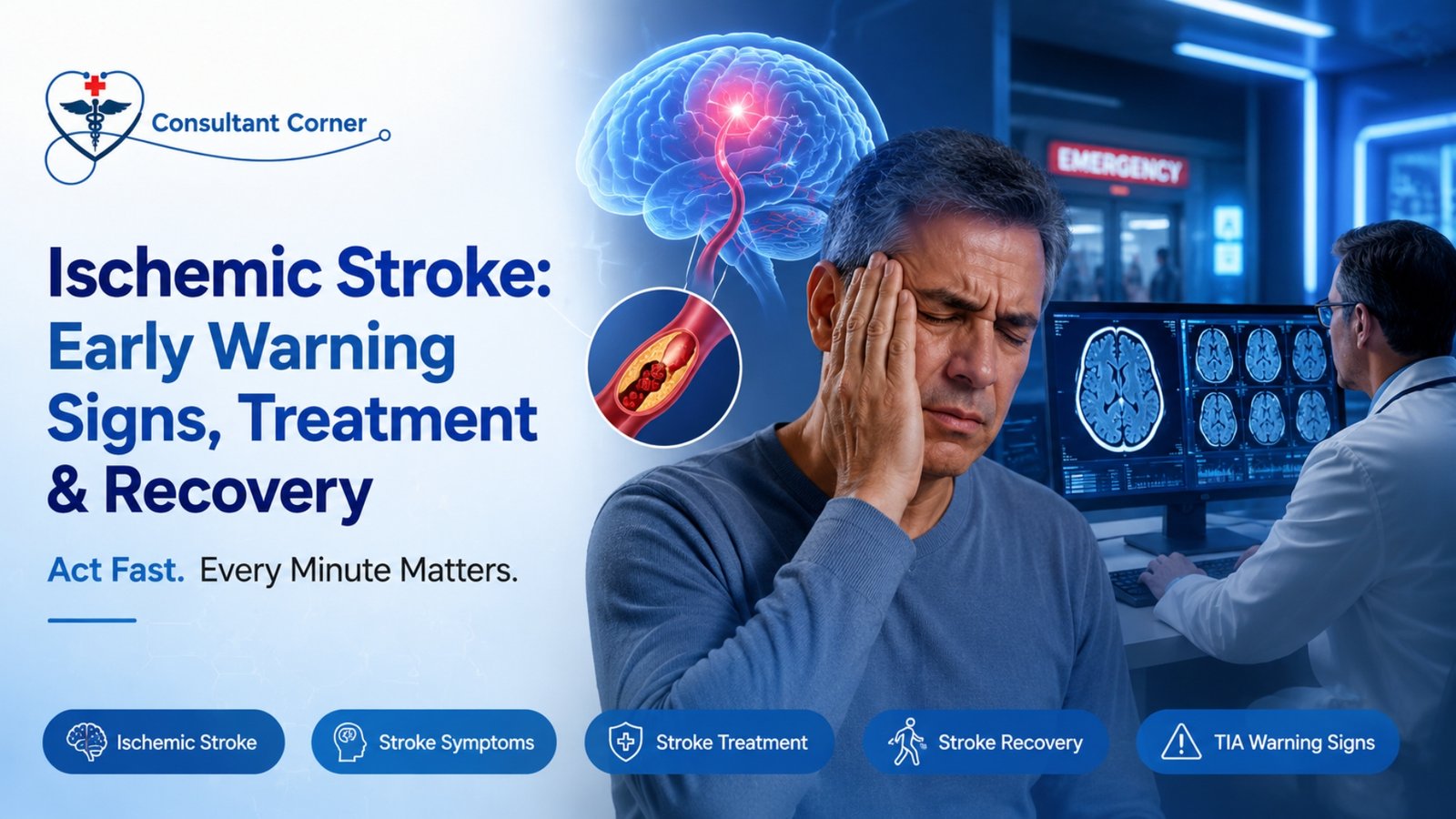
Ischemic Stroke: Early Warning Signs, Treatment and Recovery
Ischemic stroke is one of the most time-sensitive emergencies a person can face, and recognizing it within seconds can make the difference between a full recovery and permanent disability. Ischemic stroke occurs when a blood clot blocks a blood vessel supplying blood to the brain, cutting off oxygen and nutrients to brain tissue. Within minutes, brain cells begin to die, which is why doctors often say, “time is brain.” Knowing its early warning signs, available treatments, and the actual recovery process can help you or your loved one take quick action and get the right care when it matters most.
In the United States, stroke is still one of the leading causes of death and long-term disability, and the vast majority of all strokes are caused by ischemic strokes. The condition is more common in certain age groups — especially those over 55 — but it can also affect younger people, especially those with uncontrolled blood pressure, diabetes, or heart disease. Its severity often depends largely on the person’s underlying health, how quickly symptoms are recognized, and how quickly appropriate treatment is started.
This guide details everything you need to know about ischemic stroke: how to recognize it early, why immediate evaluation saves lives, who is most at risk, what treatment is like, and how the recovery process is completed. If you’d like to read more about this, you can also check out our posts Understanding TIA: The Warning Stroke You Shouldn’t Ignore and Managing High Blood Pressure to Protect Your Brain.
What Is an Ischemic Stroke?
An ischemic stroke occurs when a blood clot or fatty deposit blocks an artery that carries blood to the brain. According to the American Stroke Association, about 87% of all strokes are ischemic. Unlike hemorrhagic strokes, in which bleeding occurs in the brain, ischemic strokes are caused by a blockage that deprives brain cells of oxygen-rich blood. The longer this blockage lasts, the more brain cells die — which is why prompt diagnosis and treatment are so important.
There are two main types of ischemic strokes:
- Thrombotic strokes — A blood clot forms directly inside an artery in the brain, especially where the artery is narrowed by plaque buildup (atherosclerosis).
- Embolic strokes — A blood clot forms elsewhere in the body (often in the heart) and travels through the bloodstream to become lodged in an artery in the brain.
Both types of strokes have similar symptoms and require urgent evaluation.
Why Ischemic Stroke Is a True Medical Emergency
Every minute an ischemic stroke goes untreated, the brain loses an estimated 1.9 million neurons. That’s why emergency departments and stroke centers are built on speed — every test, every decision, and every opportunity for treatment is measured in minutes, not hours.
Recognize the Warning Signs Early
Ischemic strokes strike suddenly, often without warning. If you notice any of these symptoms — even if they occur occasionally — seek emergency help immediately:
- Sudden weakness or numbness on one side of the face, arm, or leg
- Difficulty speaking or understanding speech
- Sudden loss of vision or blurred vision
- Dizziness, loss of balance, or sudden difficulty walking
- A severe, sudden headache with no apparent cause

Use the FAST Test
The easiest way to remember the warning signs of stroke is the FAST acronym:
- F — Face drooping
- A — Arm weakness
- S — Difficulty speaking
- T — Time to call 911
These signs are your body’s warning system. They are not something to ignore or sleep on — any sign of ischemic stroke should prompt an immediate call to emergency services.
Why Immediate Stroke Evaluation Saves Lives
Taking action quickly after stroke symptoms appear can help determine if a patient is a candidate for time-sensitive treatment, including:
- tPA, which is usually given within 3 to 4.5 hours of symptom onset
- Mechanical clot removal (thrombectomy), which can be effective for certain large blood vessel blockages over a longer period of time
- Advanced stroke prevention therapy to reduce the risk of a second stroke
Even brief, transient symptoms can indicate a TIA (transient ischemic attack), sometimes called a “mini-stroke.” A TIA is often the final warning sign before a major ischemic stroke, and should never be ignored just because the symptoms have resolved on their own. Prompt evaluation after a TIA can prevent more serious, disabling strokes in the future.
| Timeline of Treatment | Intervention | Best Candidates for Intervention |
|---|---|---|
| 0–4.5 hours after attack | tPA (blood clot-busting drug) | Confirmed ischemic stroke, no risk of bleeding |
| Up to 24 hours (select cases) | Mechanical thrombectomy | Imaging confirms large vessel occlusion |
| Ongoing | Blood pressure and cholesterol control | All ischemic stroke and TIA patients |
| Ongoing | Antiplatelet or anticoagulant therapy | Patients at risk of blood clots or atrial fibrillation |
| Long-term | Rehabilitation (physical, speech, occupational) | Patients with post-stroke deficits |
Are You at Risk for Ischemic Stroke?
Some risk factors for ischemic stroke can be controlled, while others cannot. Knowing your personal risk profile is one of the most powerful tools for prevention. Common risk factors include:
- High blood pressure (a leading cause of stroke)
- Diabetes
- High cholesterol
- Atrial fibrillation or other heart disease
- Smoking or vaping
- Obesity and a sedentary lifestyle
- Previous stroke or TIA
- Family history of stroke
According to the Centers for Disease Control and Prevention, about 80% of strokes can be prevented by controlling these risk factors. If you have one or more of these conditions, it is imperative to consult a neurologist as soon as possible — prevention is almost always more effective and less expensive than treating a stroke after it has occurred.
To learn more about the heart-brain connection, you may also find it helpful to read our related article, How Atrial Fibrillation Increases Stroke Risk.
How Is Ischemic Stroke Diagnosed
When a person comes to the hospital with possible stroke symptoms, doctors quickly follow a specific evaluation process. This usually includes:
- A rapid neurological exam to assess speech, vision, strength, and coordination
- CT or MRI imaging of the brain to confirm whether the stroke is ischemic or hemorrhagic
- Blood tests to check for clotting factors, glucose, and other markers
- Imaging of the blood vessels (CT angiography or MR angiography) to detect blood vessel blockage
- Heart monitoring (ECG) to check for atrial fibrillation or other cardiac causes
This entire process is often completed in less than an hour at an accredited stroke center, as the results of each test directly determine which treatment options will be available.
Why Hospital Reports Can Be Confusing
Many patients leave the hospital with a thick pile of CT, MRI, and lab reports filled with medical jargon they don’t fully understand. This is one of the most common reasons people seek follow-up advice — so someone can explain exactly what happened, what it means, and what to do next.
Treatment Options for Ischemic Stroke
Once an ischemic stroke is confirmed, treatment decisions are made based on the time of onset of symptoms, the location and size of the blockage, and the patient’s overall health.
Immediate treatments may include:
- tPA (tissue plasminogen activator) — an intravenous medication that dissolves blood clots, which is most effective when administered quickly
- Mechanical thrombectomy — a minimally invasive procedure in which a specialist inserts a catheter into the blocked blood vessel and physically removes the clot
- Blood pressure control — This is carefully controlled to prevent further brain damage
Ongoing treatment usually includes:
- Antiplatelet medications (such as aspirin or clopidogrel) or anticoagulants for patients with atrial fibrillation
- Cholesterol-lowering medications (statins)
- Blood sugar control for diabetic patients
- Lifestyle counseling around diet, exercise, and smoking cessation

Life After Stroke: What Recovery Is Like
The recovery process from an ischemic stroke depends largely on factors such as the size and location of the affected area of the brain, how quickly treatment is given, and the patient’s overall health before the stroke. Some patients regain most of their function within a few weeks; for others, the journey is longer and requires a variety of rehabilitation procedures.
Common components of stroke recovery include:
- Physical therapy to restore strength, balance, and mobility
- Speech therapy for those who have difficulty speaking or swallowing
- Occupational therapy to relearn daily tasks like dressing, cooking, or writing
- Cognitive rehabilitation for memory, attention, or information processing difficulties
- Psychological support and counseling, as depression and anxiety are common after a stroke
Most neurologists agree that the first three to six months after a stroke are the most active time for recovery, although with regular therapy, significant improvements can continue beyond that. For more details on what daily life and a therapy schedule might look like, see our post titled What to Expect During Stroke Rehabilitation.
Why Patients Choose Consultant Corner
Your recovery — and your risk of future stroke — depends largely on receiving treatment under the supervision of the right specialist. At Consultant Corner, we offer a comprehensive approach to ischemic stroke assessment, treatment planning, and prevention:
- Expert stroke neurology evaluation — by a specialist experienced in ischemic stroke, TIA, and complex vascular problems
- Detailed review of CT/MRI and hospital reports — we explain what happened and what it means for your long-term health
- Personalized stroke prevention plan — considering your risk factors, medications, lifestyle, and follow-up strategies
- Management of post-stroke symptoms — weakness, dizziness, vision problems, memory problems, and speech difficulties — all assessed and treated
- Convenience of same-week appointments — because stroke symptoms and TIA concerns can’t wait
You get transparency, expert care, and long-term protection for your brain — all in one place.
When You Should Call 911
Avoid urgent care — go straight to the emergency department if you experience any of the following symptoms:
- New or worsening weakness
- Sudden difficulty speaking
- Severe, unexplained headache
- Fainting
- Repeated vomiting
- Sudden confusion
- Numbness or vision loss on one side of the body
A stroke is always an emergency. Do not drive yourself — call 911 so emergency personnel can begin assessing you on the way to the hospital.
Frequently Asked Questions About Ischemic Stroke
What is the difference between an ischemic stroke and a hemorrhagic stroke? An ischemic stroke is caused by a blockage in the blood supply to the brain, while a hemorrhagic stroke is caused by bleeding in or around the brain. Ischemic strokes are much more common, accounting for about 87% of all strokes.
How quickly do ischemic stroke symptoms appear? Symptoms usually come on suddenly, within seconds to minutes, and may include facial drooping, arm weakness, and difficulty speaking. Some symptoms may fluctuate or improve for a short time, but this does not mean that the danger is over.
Can a TIA turn into a full-blown ischemic stroke? Yes. A transient ischemic attack (TIA) is often called a “mini-stroke” and is one of the strongest warning signs that a major ischemic stroke may follow, sometimes within a few days. Anyone experiencing symptoms of a TIA should seek emergency medical attention immediately.
What is the optimal time frame for tPA treatment? tPA is usually most effective when given within 3 to 4.5 hours of symptoms, so it is important to recognize symptoms quickly and call 911 immediately.
How long does it take to recover from an ischemic stroke? Recovery time varies from person to person. Many patients see the most significant improvement within the first three to six months, although improvement may take a year or more with ongoing therapy.
Who is at highest risk for ischemic stroke? Those with high blood pressure, diabetes, high cholesterol, atrial fibrillation, smoking, obesity, or a family history of stroke are at higher risk. Age is also a factor, with the risk increasing significantly after age 55.
Should I see a specialist after a stroke or TIA, even if I feel well? Yes. Even if symptoms have gone away, an evaluation by a specialist can help identify the underlying cause and develop a prevention plan to reduce the risk of more serious strokes in the future.
Schedule Your Stroke Evaluation Today
If you have recently had a stroke or TIA, or are noticing new neurological symptoms, the safest next step is to be evaluated by a specialist. At Consultant Corner, we help you understand your risks, create a personalized prevention plan, and protect your long-term brain health.
Book Your Appointment Today — Call or Request Online. Same-week appointments are available for stroke and TIA concerns.