Post-Stroke Recovery & Rehabilitation
The recovery process following a stroke is a dynamic neurological journey driven by neuroplasticity, the brain’s remarkable ability to reorganize itself by forming new neural connections. When a stroke occurs, damaging specific regions, the brain begins to “rewire” around the injury, allowing healthy areas to compensate for lost functions. What truly drives this stroke recovery is a combination of immediate clinical intervention and high-intensity, repetitive rehabilitation that “teaches” the brain how to move, speak, and process information again. By staying committed to a structured therapy plan and utilizing the latest neurological breakthroughs, patients can significantly improve their long-term prognosis and reclaim their independence.
Stroke Recovery Is a Neurological Process Not a Waiting Period
A stroke is not simply a sudden medical event; it is a neurological injury that disrupts the brain’s ability to control movement, speech, cognition, behavior, and vital bodily functions. Whether caused by an ischemic blockage or an intracerebral hemorrhage, stroke results in acute damage to brain tissue followed by a complex and evolving recovery process.
In the United States, nearly 800,000 people experience a stroke each year, making it one of the leading causes of long-term neurological disability. Advances in acute stroke treatment have significantly improved survival. However, survival is only the beginning. What follows is a prolonged and highly individualized process of neurological recovery.
For patients and families, this phase is often filled with uncertainty:
Will strength return? Will speech improve? How long does recovery take? Is rehabilitation truly effective?
From a neurological standpoint, recovery is best understood through two core principles:
- Stroke recovery is driven by brain plasticity, not time alone
- Rehabilitation is an active neurological treatment, not supportive care
Understanding these principles helps patients and caregivers move forward with clarity, realistic expectations, and hope.
How the Brain Heals After Stroke - Understanding Neuroplasticity
When a stroke occurs, part of the brain is injured or deprived of blood flow, leading to loss of neurons and disruption of neural networks. Importantly, this injury does not mean the brain is incapable of recovery. Instead, recovery depends on how surviving brain regions adapt over time, a process known as neuroplasticity.
What Is Neuroplasticity?
Neuroplasticity refers to the brain’s ability to reorganize, strengthen existing connections, and form new neural pathways in response to injury and experience. After a stroke, unaffected areas of the brain can partially assume functions previously handled by damaged regions. This biological adaptability is the foundation of rehabilitation.
Crucially, neuroplasticity is activity-dependent. The brain does not reorganize simply with rest or time. Recovery is driven by repetitive, meaningful, task-specific practice, which is why structured rehabilitation is so effective.
Early and Late Brain Recovery
In the first days to weeks after a stroke, the brain enters a period of heightened plasticity. Swelling subsides, inflammation decreases, and neural signaling stabilizes. During this phase, early improvements may reflect recovery of stunned but viable tissue.
While the most rapid gains often occur within the first 3–6 months, recovery does not stop there. Research shows that meaningful improvement can continue for 6–12 months and beyond, particularly when rehabilitation remains progressive and goal-directed.
Later recovery often involves:
- Refinement of motor control rather than large strength gains
- Improved balance, coordination, and endurance
- Gradual improvements in language and cognition
- Development of compensatory strategies that enhance independence
The idea that recovery “plateaus” early is often a reflection of reduced therapy intensity or lack of reassessment, not a true limit of neurological potential.
Rehabilitation Therapies That Drive Recovery
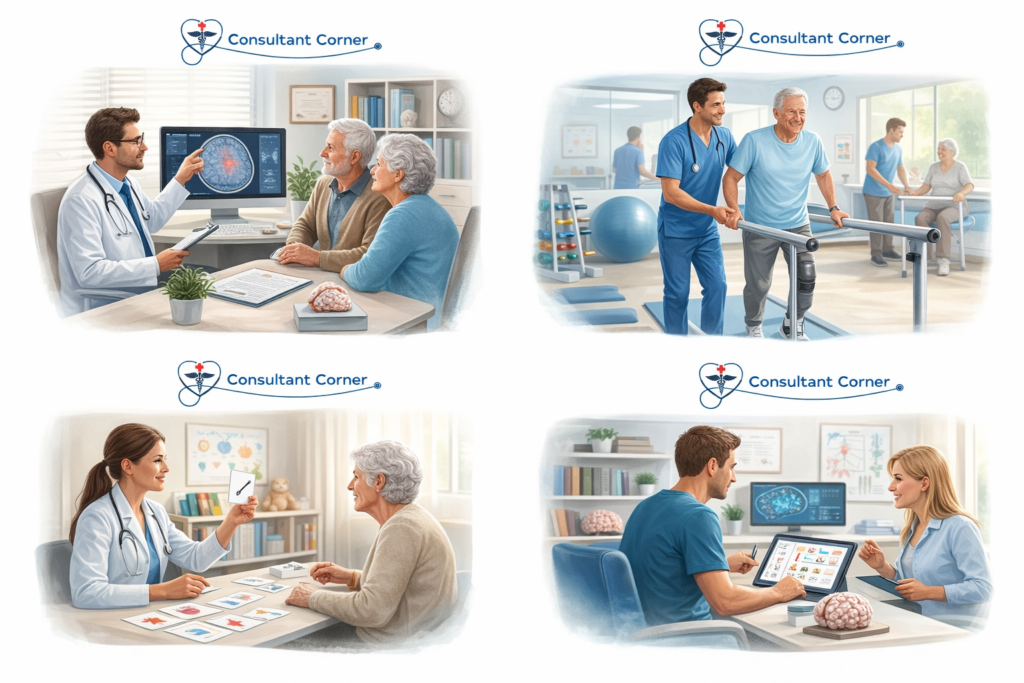
Stroke rehabilitation is not a single therapy or a one-size-fits-all program. It is a multidisciplinary neurological intervention designed to retrain the brain by engaging impaired neural networks repeatedly and purposefully.
Physical Therapy - Restoring Mobility and Balance
Physical therapy focuses on improving strength, coordination, balance, and gait. Weakness, spasticity, and impaired balance are common after a stroke and significantly affect independence.
Through task-oriented and repetitive movement training, physical therapy helps the brain re-map motor pathways, reduce fall risk, and improve functional mobility. Therapy evolves, from basic transfers to higher-level balance, endurance, and community mobility.
Speech and Language Therapy - Communication and Swallowing
Stroke can affect language (aphasia), speech clarity (dysarthria), cognition, and swallowing (dysphagia). Speech-language therapy addresses:
- Language comprehension and expression
- Speech articulation and voice control
- Cognitive-communication skills
- Swallowing safety and nutrition
Recovery in this domain may be gradual, but meaningful gains can continue long after motor recovery stabilizes. Early swallowing evaluation is essential to reduce aspiration risk and medical complications.
What Really Predicts Stroke Recovery
Recovery is shaped by multiple interacting factors, not a single variable.
What Matters Most:
- Quality, timing, and intensity of rehabilitation
- Patient engagement and education
- Ongoing neurological oversight
- Social and caregiver support
- Management of medical and neurological complications
Preventing Complications and Secondary Stroke
Recovery must occur alongside secondary stroke prevention. Stroke survivors face an increased risk of recurrence, particularly in the first year.
Key elements include:
- Control of blood pressure, diabetes, and cholesterol
- Management of atrial fibrillation or other cardiac conditions
- Medication adherence (antiplatelets, anticoagulants, statins)
- Fall prevention and safety strategies
- Treatment of spasticity, pain, seizures, fatigue, and sleep disorders
Neurologists help tailor prevention strategies to the stroke mechanism and individual risk, ensuring protection of recovery gains.
Long-Term Recovery - Months to Years After Stroke
Recovery does not end when formal therapy becomes less frequent. Long-term recovery often involves refinement rather than dramatic change, including better coordination, endurance, language fluency, and confidence.
The concept of a “plateau” is often misleading. Reassessment frequently reveals opportunities for renewed therapy, adaptive strategies, or technology-assisted rehabilitation.
Long-term goals may include:
- Returning to work or hobbies
- Driving evaluation
- Managing fatigue
- Enhancing independence and safety
Neurological follow-up ensures recovery plans evolve alongside life goals.
Caregivers, Technology, and the Future of Recovery
Caregivers play a central role in reinforcing therapy, ensuring safety, and supporting emotional adjustment. Education reduces burnout and improves outcomes for both patients and families.
Technology and tele-rehabilitation are increasingly important, especially for patients with mobility or access limitations. Virtual therapy, wearable monitoring, and tele-neurology support continuity of care and long-term engagement.
The future of stroke recovery lies in personalized, neurologist-guided rehabilitation enhanced by thoughtful use of technology.
- +1 888 208 2208
- info@myconsultantcorner.com
- Monday to Friday
[8:00 AM - 5:00 PM]
How Consultant Corner Supports Post-Stroke Recovery
Stroke recovery is a longitudinal neurological journey, not a single episode of care. Consultant Corner provides neurologist-led, evidence-based guidance throughout every phase of recovery.
We support patients and families by:
- Interpreting recovery trajectories
- Adjusting rehabilitation strategies
- Managing late-emerging complications
- Coordinating care across disciplines
- Providing accessible virtual neurology follow-up
Our goal is to help patients continue making meaningful gains, with clarity, confidence, and expert neurological support.
Consultant Corner — Thoughtful, Evidence-Based Neurology Care for Recovery and Beyond.
Frequently Asked Questions
Can the brain truly "heal" after a stroke has caused cell death?
While dead brain cells cannot be replaced, the brain possesses a remarkable ability called neuroplasticity. This allows healthy areas of the brain to “rewire” themselves, forming new neural pathways to take over functions previously managed by the damaged regions. Recovery is less about replacing cells and more about teaching the remaining brain tissue new ways to communicate.
How long does the "stroke recovery window" actually last?
While the most rapid gains are often seen in the first 3 to 6 months, the “window” for recovery never truly closes. Research shows that with consistent, high-intensity rehabilitation and the right neurological support, patients can continue to make functional gains and improve their quality of life years after the initial event.
What is the single most important factor in driving recovery?
Consistency and repetition are the primary drivers of neuroplasticity. The brain requires “task-specific” practice—meaning if you want to regain hand movement, you must repeatedly practice hand-oriented tasks. This repetitive stimulation signals the brain that a specific function is necessary, triggering the formation of new neural connections.
Why do some stroke survivors experience a "recovery plateau"?
A plateau often occurs when the initial, rapid phase of healing slows down. However, a plateau is usually a sign that the brain needs a change in the intensity or type of stimulation. By adjusting your therapy plan, incorporating new technologies or different therapeutic exercises—we can often “jump-start” progress again.
How do lifestyle factors like diet and sleep affect brain healing?
The brain requires an immense amount of energy to rewire itself. A neuro-protective diet rich in Omega-3s and antioxidants provides the “building blocks” for new synapses, while deep sleep is when the brain processes and solidifies the motor skills learned during the day’s therapy sessions.
Can emotional health impact physical recovery after a stroke?
Absolutely, depression and anxiety can chemically hinder neuroplasticity by increasing cortisol levels, which may suppress the brain’s ability to form new connections. Addressing mental health through counseling or medical support is often a critical, though sometimes overlooked, component of a successful stroke recovery plan.