A patient-centered guide- from Consultant Corner
Alzheimer’s disease is the most common cause of dementia worldwide and one of the fastest-growing public health challenges of our time. More than 6.7 million Americans are currently living with Alzheimer’s disease, and that number is projected to rise sharply over the coming decades as the population ages. Despite its prevalence, Alzheimer’s disease is still widely misunderstood, frequently underdiagnosed, and often identified later than it should be.
Many families dismiss early symptoms as “normal aging,” while others delay evaluation because of fear or uncertainty. However, research and clinical experience consistently show that early recognition, early diagnosis, and early intervention can improve outcomes, providing more time to plan, reducing avoidable complications, and allowing eligible patients to access modern treatment strategies sooner.
At Consultant Corner, we believe Alzheimer’s care should be proactive, personalized, and compassionate. Through expert neurology care, cognitive testing coordination, caregiver education, and virtual neurology access, we help patients and families navigate memory concerns with clarity and confidence.
🧬 What Is Alzheimer’s Disease?
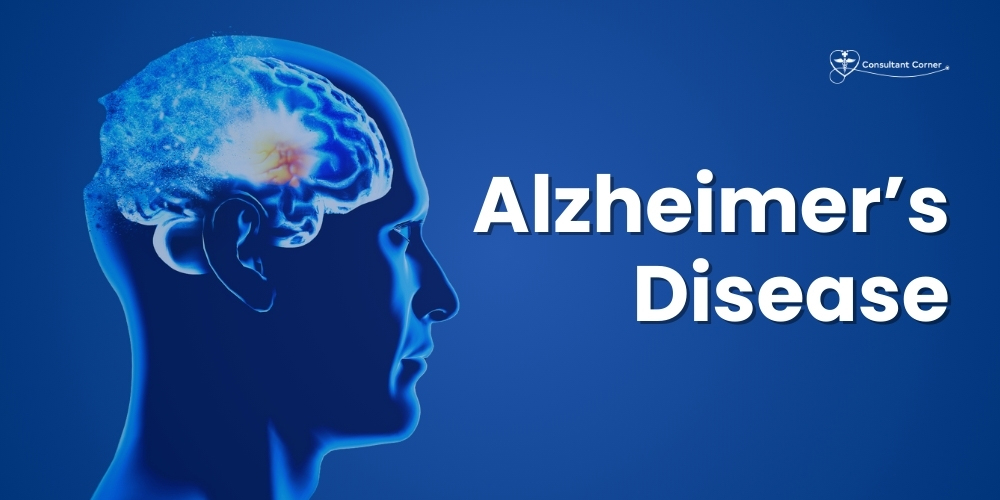
Alzheimer’s disease is a progressive neurodegenerative disorder that gradually damages brain cells and disrupts the networks responsible for memory, learning, reasoning, and behavior. Unlike temporary forgetfulness or reversible cognitive conditions, Alzheimer’s causes ongoing brain changes that worsen over time.
🧠 What Happens in the Brain (Pathophysiology)
Alzheimer’s disease is closely associated with two abnormal protein processes that interfere with normal brain function:
· Amyloid‑beta plaques: Sticky protein fragments accumulate between neurons (brain cells), disrupting communication and triggering inflammation.
· Tau protein tangles: Abnormal tau builds up inside neurons, damaging the internal “support structure” and leading to cell dysfunction and death.
As these proteins accumulate and spread, the brain experiences loss of synapses (connections), reduced neurotransmitter signaling, and progressive shrinkage (atrophy) of key regions, especially the hippocampus, which is crucial for forming new memories. Over time, these changes impair the brain’s ability to store new information, retrieve details, regulate emotions, and perform complex tasks.
Importantly, Alzheimer’s-related brain changes can begin years (sometimes decades) before noticeable symptoms appear, which is why early evaluation and baseline cognitive testing can be so valuable.
🚨 Early Signs of Alzheimer’s Disease
Alzheimer’s disease often begins subtly. Symptoms may appear mild at first and can be mistakenly attributed to stress, sleep problems, depression, or normal aging. But early changes represent a crucial window for evaluation, when education, safety planning, risk factor optimization, and treatment decisions can make a meaningful difference.
- Short‑term memory loss that disrupts daily life (forgetting recent conversations or appointments)
- Repeating questions, statements, or stories without realizing it
- Word-finding difficulty or trouble following conversations
- Struggling with finances, medications, or multi-step tasks
- Getting lost in familiar places or increased disorientation
- Changes in judgment, problem-solving, or decision-making
- Withdrawal from social activities, hobbies, or work responsibilities
- New or worsening anxiety, depression, irritability, or apathy
As Alzheimer’s disease progresses, symptoms can expand to include confusion about time or place, changes in personality or behavior, visual‑spatial problems, hallucinations or delusions, difficulty with basic daily activities, and increased dependence on caregivers.
Important: Not all memory problems are Alzheimer’s disease. Depression, sleep disorders, vitamin deficiencies, thyroid issues, medication side effects, hearing loss, and other neurological conditions can mimic dementia, which is why expert evaluation matters.
🧠 How Alzheimer’s Disease Is Diagnosed
Accurate diagnosis requires a structured, multidimensional approach-not just a single memory screen. A high-quality evaluation looks for reversible causes, identifies patterns of cognitive change, and clarifies whether symptoms fit Alzheimer’s disease or another condition.
A comprehensive memory evaluation may include:
- Detailed neurological exam and review of symptoms over time
- Medical history (including medications) and family history
- Cognitive screening tools as an initial assessment
- Formal neuropsychological testing for deeper, domain-specific evaluation
- Laboratory testing to rule out reversible contributors (e.g., vitamin deficiencies, thyroid dysfunction)
- Brain imaging (MRI or CT) to evaluate structural brain changes and rule out other causes
- Advanced biomarkers (when appropriate) to support diagnostic clarity and treatment planning
🧠 Neuropsychological Testing: Why It’s So Helpful
Neuropsychological testing is one of the most valuable tools in modern memory care. It provides a detailed map of brain function across multiple domains, such as memory, attention, language, executive function, processing speed, and visual‑spatial skills. This helps clinicians:
- Differentiate Alzheimer’s disease from other dementias and cognitive disorders
- Establish a baseline to track progression over time
- Identify strengths that can be leveraged for daily functioning
- Guide personalized treatment, safety planning, and caregiver education
Through virtual neurology, Consultant Corner can help coordinate early memory evaluations, testing referrals, and longitudinal follow-up-even for patients who have difficulty traveling.
💊 Current & Emerging Treatments for Alzheimer’s Disease
While there is not yet a cure for Alzheimer’s disease, today’s treatment strategy is more robust than ever. Modern care focuses on three pillars:
- symptom-targeted medications,
- disease-modifying therapies for appropriate patients, and
- comprehensive supportive care.
1️⃣ Symptomatic Medications (Cognition & Function)
Traditional FDA-approved medications are commonly used to support memory and daily functioning. These may help stabilize symptoms for some patients and slow functional decline:
· Cholinesterase inhibitors (e.g., donepezil, rivastigmine, galantamine) — support acetylcholine signaling important for learning and memory
· NMDA receptor antagonist (memantine) — helps regulate glutamate signaling, which can influence cognition and behavior
2️⃣ Disease‑Modifying Therapies (A New Era of Memory Care)
In recent years, disease‑modifying therapies targeting amyloid‑beta have changed the Alzheimer’s landscape. These therapies aim to slow progression in select patients, typically those in earlier symptomatic stages and with appropriate biomarker confirmation. Because these treatments can require careful monitoring and shared decision‑making, a neurology-guided evaluation is essential.
- Not every patient is a candidate — selection depends on stage, overall health, and testing results
- Treatment often requires ongoing monitoring and follow-up
- Risk-benefit discussions should include patients and caregivers
Consultant Corner helps patients and families understand candidacy, coordinate evaluations, and build a safe, realistic long-term plan.
🌱 Beyond Medications: Comprehensive Alzheimer’s Care
The most effective Alzheimer’s care goes beyond prescriptions. Comprehensive care focuses on maintaining independence, reducing complications, and supporting caregivers. This may include structured routines, cognitive stimulation, environmental modifications, and managing medical conditions that can worsen cognition (sleep apnea, depression, hearing loss, uncontrolled blood pressure, and diabetes).
✅ Practical Strategies That Make a Big Difference
- Establish consistent daily routines to reduce confusion and agitation
- Use calendars, reminders, pill boxes, and simplified task lists
- Optimize sleep and treat sleep disorders when present
- Encourage safe physical activity and social engagement
- Address hearing/vision problems to reduce cognitive load
- Review medications to reduce those that may worsen confusion
- Nutrition and hydration planning to prevent delirium and weakness
🏠 Safety Planning & Common Complications
As Alzheimer’s disease progresses, safety becomes a central part of care. Planning early helps reduce crises later. Common risks include medication errors, wandering, falls, driving-related safety issues, malnutrition, and caregiver burnout.
- Driving safety: consider a formal assessment when concerns arise
- Medication supervision: reduce missed doses and double-dosing
- Home safety: remove trip hazards, improve lighting, add grab bars
- Wandering prevention: door alarms, ID bracelets, safety plans
- Fall prevention: strength/balance work, footwear, assistive devices when needed
Later-stage complications can include swallowing problems, increased infections, immobility, behavioral symptoms, and increased caregiver strain. A proactive care team can help reduce avoidable hospitalizations and preserve quality of life.
The Critical Role of Caregivers & Support Systems
Caregivers are the backbone of Alzheimer’s care. Over time, caregivers often manage medications, appointments, finances, safety planning, and daily living needs. Without support, caregiver burnout is common-and it directly affects patient outcomes.
🧠 Caregiver Education: What Families Need
At Consultant Corner, caregiver education is integrated into care planning. We help families understand what to expect, how to manage symptoms, and how to build a sustainable support system.
- Understanding progression and what changes are expected over time
- How to respond to agitation, confusion, sleep disruption, or behavioral changes
- Communication strategies that reduce frustration and conflict
- Planning for future care needs, safety, and legal/financial considerations
- Connecting to community resources and caregiver support programs
🔮 The Future of Alzheimer’s Disease Care
Alzheimer’s research is moving quickly toward earlier detection and more targeted therapies. Many innovations are reshaping clinical practice and expanding options for patients and families.
- Blood-based biomarkers for earlier and more accessible detection
- More precise imaging and biomarker-guided treatment selection
- Combination therapies targeting multiple pathways (amyloid, tau, inflammation)
- Personalized medicine approaches based on risk profiles and clinical patterns
- AI-assisted cognitive monitoring and remote follow-up models
- Expanded access through tele-neurology and hybrid care pathways
These advances reinforce one key message: the sooner we evaluate memory changes, the more options we may have for treatment planning, safety, and support.
🌐 How Consultant Corner Helps Patients With Memory Concerns
Consultant Corner provides modern, patient-centered Alzheimer’s and memory care with an emphasis on early evaluation, education, and long-term partnership. We support patients and families through diagnostic clarity, treatment planning, and ongoing follow-up, virtually or in person when needed.
- Expert neurological evaluation for memory loss and cognitive concerns
- Coordination of cognitive testing and neuropsychological assessment
- Medication optimization and treatment planning (including discussing newer therapies when appropriate)
- Caregiver education, safety planning, and long-term guidance
- Virtual neurology visits for convenient follow-up and continuity
📞 Ready for Early Memory Testing? Reach Out Today.
If you or a loved one is noticing memory changes, word-finding difficulty, confusion, or changes in daily functioning, we encourage you to seek evaluation sooner rather than later. Early memory testing helps clarify what’s happening, identifies reversible contributors, and opens the door to earlier support and planning.
Please feel free to reach out to Consultant Corner with any questions. Our team is here to help you understand symptoms, coordinate testing, and build a personalized care plan.
📱 Phone: +1 (888) 208–2208
📧 Email: info@myconsultantcorner.com
🌐 Website: https://myconsultantcorner.com
Consultant Corner — Advancing Memory Care Through Expertise, Technology & Compassion.