
A head injury can happen in the blink of an eye — a bathroom fall, a car collision, a sports impact, or even a careless bump into a cabinet door. But the consequences can ripple through days, weeks, or even months of your life. Understanding what a head injury actually means, recognizing when symptoms signal danger, knowing what recovery looks like, and learning when to call a doctor can make a real difference in how quickly — and how completely — you or someone you love gets better.
This comprehensive guide covers everything you need to know about head injury: the different types, common and emergency symptoms, the stages of recovery, special populations at risk, how doctors diagnose injury, and the steps you can take today to protect your brain health.
What Is a Head Injury?
A head injury is any form of trauma to the scalp, skull, or brain. The spectrum is wide — it can range from a minor bump that leaves a small lump, all the way to a traumatic brain injury (TBI) that disrupts memory, mood, movement, or consciousness. Not every head injury directly involves the brain. A scalp laceration may bleed dramatically (scalp tissue is highly vascular) but involve no brain trauma at all. Conversely, a head injury that looks minor on the surface can still cause significant damage to the brain beneath the skull.
Medically, head injuries fall into two primary categories:
Closed Head Injuries — The skull remains intact, but the brain can still be jolted, bruised, or twisted inside the cranial cavity. The most common type in this category is a concussion, which occurs when the brain moves rapidly within the skull and temporarily disrupts normal brain function. Closed head injuries represent roughly 75% of all traumatic brain injuries in the United States annually.
Open (Penetrating) Head Injuries — An object breaches the skull and may directly damage brain tissue. These are generally more severe, almost always require emergency surgical intervention, and carry a higher risk of permanent neurological damage.
Within both categories, a head injury is further classified by severity — mild, moderate, or severe — based on whether the person lost consciousness, how long confusion lasted, and what brain imaging reveals.
How Common Is Head Injury?
Head injury is far more common than most people realize. According to data from the Centers for Disease Control and Prevention (CDC), approximately 1.7 million traumatic brain injuries occur in the United States each year, with about 3% resulting in death. Adults are the most frequently affected group, though children and older adults face their own heightened risks.
Common Causes of Head Injury
The cause of a head injury often shapes the type and severity of damage. The most common causes include:
Falls — Falls are the leading cause of head injury overall, particularly in young children and adults over age 65. Poor balance, vision changes, and medications that impair coordination all increase fall risk in older adults.
Motor Vehicle Accidents — The forces involved in car collisions tend to produce more severe injuries. Whiplash-type movements can cause the brain to strike the interior of the skull even when there is no direct head impact.
Sports-Related Impacts — Contact sports like football, soccer, rugby, hockey, and boxing frequently produce concussions. Even cycling and skiing carry significant head injury risk without proper helmet use.
Workplace Accidents — Construction and industrial workers face elevated risk from falling objects, falls from elevated platforms, or machinery-related impacts.
Physical Assaults — Blunt force trauma to the head during assaults accounts for a meaningful percentage of emergency department head injury presentations.
Understanding the cause matters because high-energy impacts — such as those in motor vehicle accidents or falls from height — carry a much higher likelihood of serious brain injury even when initial symptoms appear mild.
Head Injury Symptoms: What to Watch For
One of the most critical things to understand about a head injury is that symptoms do not always appear immediately. They can emerge hours — sometimes even a day or two — after the initial trauma. This delayed onset is precisely why anyone who has sustained a head injury should be monitored closely for at least 24 to 48 hours, even if they feel completely fine at first.
Common Symptoms of a Head Injury
- Persistent or worsening headache
- Dizziness or problems with balance and coordination
- Nausea or vomiting
- Confusion, mental fog, or difficulty concentrating
- Memory problems, especially difficulty recalling the injury event itself (post-traumatic amnesia)
- Sensitivity to light (photophobia) or noise (phonophobia)
- Unusual fatigue or drowsiness
- Irritability, mood swings, or heightened anxiety
- Ringing in the ears (tinnitus) or blurred vision
- Disrupted sleep — either difficulty falling asleep or sleeping far more than usual
These symptoms overlap considerably with other neurological conditions. For instance, persistent headache after a head injury can mimic the presentation of a migraine disorder. If you’re uncertain whether your headache is related to trauma or to a primary headache condition, our blog post Understanding Headache / Migraine explores how different headache types present and how neurologists distinguish between them.
Similarly, dizziness and balance problems following a head injury can sometimes overlap with conditions like vertigo. Our resource on Vertigo & Dizziness explains how these symptoms are assessed and when they require specialist evaluation.
Emergency Warning Signs After a Head Injury
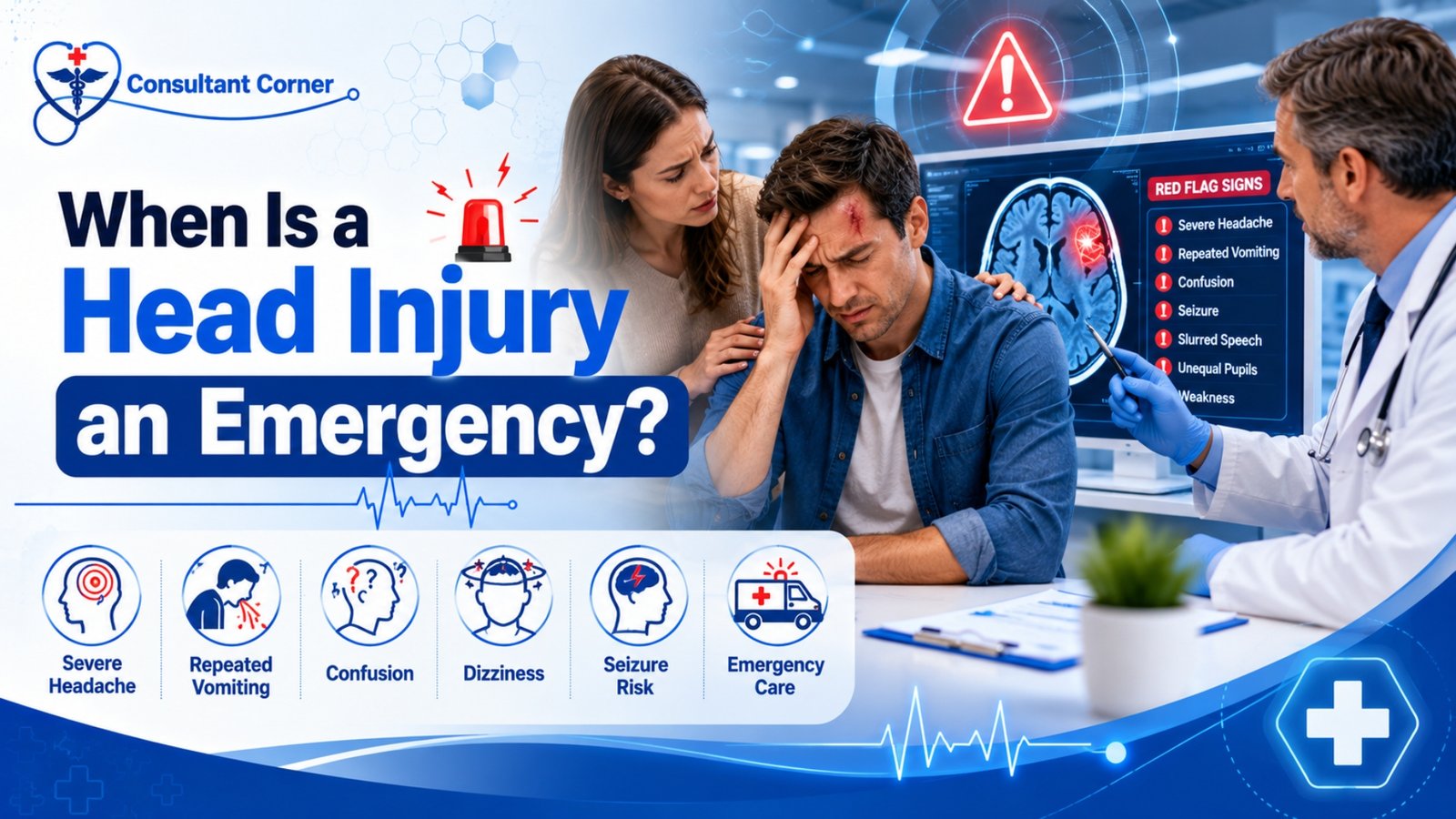
While many head injury symptoms can be managed with rest and at-home monitoring, certain signs demand immediate emergency care. Brain swelling and internal bleeding can develop without any visible external injury. These are conditions that can rapidly become life-threatening if not addressed urgently.
Call 911 or Go to the Emergency Room Immediately If:
- The headache rapidly intensifies rather than easing
- There is repeated or forceful vomiting (more than once or twice)
- The person has slurred speech or sudden difficulty finding words
- A seizure or convulsion occurs
- One pupil is noticeably larger than the other (unequal pupils)
- The person shows growing confusion, extreme disorientation, or dramatic behavioral change
- There is any loss of consciousness, even briefly
- One or more limbs feel weak or numb
- Clear fluid or blood is leaking from the nose or ears (a potential sign of basilar skull fracture)
- The person cannot be woken after falling asleep post-injury
These red-flag symptoms suggest potentially life-threatening complications such as an epidural hematoma, subdural hematoma, or diffuse brain swelling — all of which require rapid neurosurgical evaluation. Do not wait to “see if things improve” when these signs are present. Minutes matter.
Head Injury in Special Populations
Not everyone faces the same level of risk from a head injury. Two groups deserve particular attention: children and older adults.
Head Injury in Children
Children’s brains are still actively developing, making them respond differently to trauma than adult brains. Younger children often cannot clearly articulate what they’re feeling, which means caregivers must watch for behavioral indicators: excessive or inconsolable crying, unusual sleepiness, refusal to eat or drink, vomiting, or loss of recently acquired skills like walking or talking. Any loss of consciousness in a child should prompt an immediate medical evaluation, regardless of how brief the episode was.
Head Injury in Older Adults
Seniors face a uniquely elevated risk for serious complications after what might seem like a minor head injury. Several factors converge to increase that risk:
- Many older adults take blood-thinning medications (anticoagulants or antiplatelets) for cardiovascular conditions. These medications can cause even minor internal bleeding to continue unchecked, leading to dangerous hematomas.
- Natural age-related brain atrophy creates more space between the brain and skull. This means the brain can shift more on impact, stretching bridging veins and increasing subdural hematoma risk — sometimes without obvious symptoms for days.
- Balance problems, vision decline, and medication side effects all increase fall risk in the first place.
For families caring for an aging parent or relative, being alert to subtle changes in cognition, balance, or behavior after any fall — even one that seemed inconsequential — is essential.
Athletes and Repeated Head Injury
Athletes who participate in contact sports face a cumulative risk that deserves special mention. Each concussion, even a mild one, can increase susceptibility to more pronounced symptoms with the next impact. This is sometimes called the “second impact syndrome” when it occurs before full recovery. Any athlete who has sustained a concussion should receive medical clearance before returning to play — a guideline supported by every major sports medicine organization.
People on Blood Thinners
Individuals taking warfarin, rivaroxaban, apixaban, clopidogrel, or similar medications should seek immediate medical evaluation after any head injury, even if symptoms seem mild. The bleeding risk is significantly elevated, and what looks like a minor bump can conceal dangerous intracranial bleeding.
How Doctors Diagnose a Head Injury
When a patient presents to a neurologist or emergency physician following a head injury, the evaluation typically involves several components working together:
Detailed History — The provider will ask precisely how the injury occurred, whether there was any loss of consciousness, how long any confusion lasted, and what symptoms developed in the hours since.
Neurological Examination — This assesses reflexes, eye movement, pupil response, coordination, balance, and basic motor function. Abnormalities here can point toward more significant structural injury.
Cognitive Screening — Tests of attention, short-term memory, working memory, and processing speed help characterize the functional impact of the injury on the brain.
Brain Imaging — Not every head injury requires imaging. A CT scan is typically ordered when there is concern about bleeding, fracture, or significant structural injury. MRI may be used later for more detailed structural assessment or when CT is inconclusive. Many mild concussions are diagnosed based purely on symptoms and clinical exam.
Standardized Concussion Tools — Tools like the SCAT (Sport Concussion Assessment Tool) or ImPACT testing may be used in athletic settings to establish baseline comparisons and track recovery.
Head Injury Recovery: What to Expect
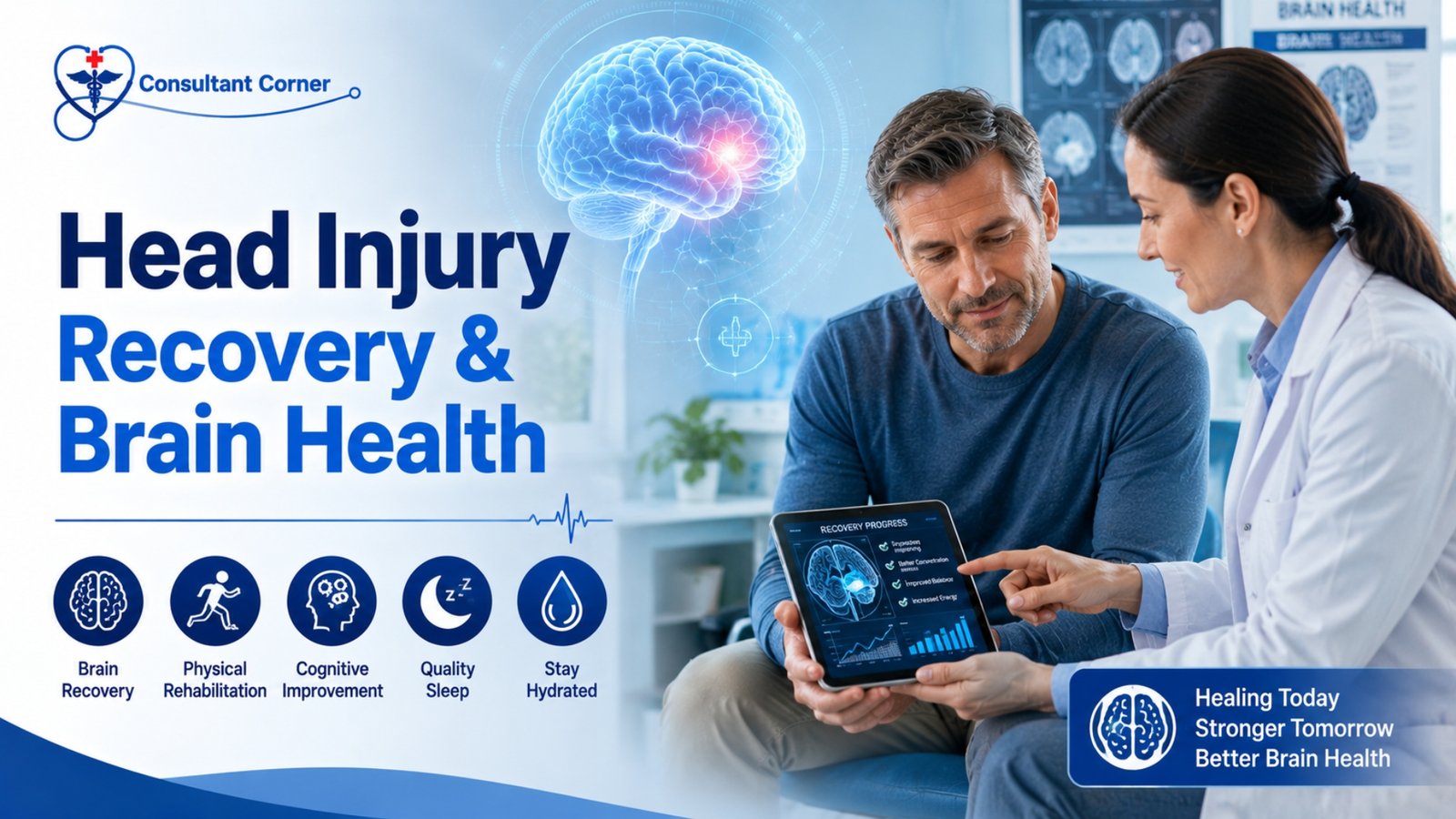
Recovery from a head injury is highly individualized. The severity of the injury, the person’s age, their pre-existing health conditions, and whether they’ve had prior head injuries all play significant roles. A mild concussion may resolve within one to two weeks with proper rest. Moderate to severe injuries can require months of structured rehabilitation.
The Phases of Head Injury Recovery
Acute Phase (First 24–72 Hours) This is the most critical monitoring window. Symptoms can evolve rapidly during this period, for better or worse. Physical and cognitive rest are essential. Screen time, reading, bright lights, and physical exertion should all be minimized. This is also the period when emergency symptoms, if they’re going to appear, are most likely to emerge.
Early Recovery (Days to 2 Weeks) Headache, fatigue, and concentration difficulties begin to ease gradually for most people with mild head injuries. Activities are reintroduced slowly and incrementally. Contact sports and any activity risking a second head impact must be avoided until full clearance.
Extended Recovery (Weeks to Months) For moderate or severe injuries, or for those who return to activity too quickly, some symptoms — particularly cognitive ones like memory difficulties, attention problems, or emotional dysregulation — can persist significantly longer. Structured rehabilitation involving a neurologist, neuropsychologist, physical therapist, or occupational therapist may be necessary.
Practical Recovery Tips After a Head Injury
- Rest both body and mind during the first 24 to 48 hours — this means limiting screen time, reading, and mentally demanding tasks, not just physical activity
- Avoid alcohol, which can mask warning symptoms and delay healing
- Prioritize consistent, quality sleep — the brain heals most efficiently during sleep
- Stay well hydrated and maintain regular, nourishing meals
- Keep a daily symptom log and report any symptoms that worsen rather than improve
- Avoid driving until you have received medical clearance, especially if dizziness or concentration problems are present
- Do not return to contact sports or physically demanding work without explicit clearance from your doctor
If you experience persistent symptoms weeks after a head injury — particularly ongoing headaches, dizziness, difficulty concentrating, or mood changes — this is a signal to pursue specialist evaluation rather than simply waiting it out. Conditions like post-concussion syndrome are real, recognized medical diagnoses that respond to targeted treatment. Our post Can Bad Posture Cause Headaches? also touches on how secondary musculoskeletal issues can develop after injury and mimic or compound post-injury symptoms.
When to Seek Medical Care for a Head Injury
A practical rule of thumb: if you are genuinely unsure whether a head injury is serious, treat it as though it might be. The downside of getting checked and being told everything is fine is minimal. The downside of missing early signs of intracranial bleeding or swelling is potentially life-altering.
Seek medical evaluation for a head injury when:
- There was any loss of consciousness, however brief
- Symptoms are worsening rather than improving over the first 24 to 72 hours
- The person shows confusion, slurred speech, or uncharacteristic behavior
- The injury involved significant force — car accident, fall from height, high-speed sports collision
- The person takes blood-thinning medications or has a bleeding disorder
- The person is a young child or elderly adult
- The headache is described as “the worst headache of my life” — a phrase that sometimes signals bleeding around the brain
- Any of the emergency warning signs listed above are present
For people unsure whether their symptoms require urgent in-person evaluation or can be safely monitored at home, a telehealth neurology consultation can be a valuable first step. Our neurologists at MyConsultantCorner provide expert online consultations to help you determine the appropriate level and urgency of care.
Preventing Head Injury: Practical Steps That Work
While no strategy can eliminate head injury risk entirely, several evidence-based measures meaningfully reduce it:
- Wear a properly fitted helmet during cycling, skiing, skating, and contact sports. Helmets reduce the risk of serious head injury by up to 85% in cyclists, according to research published in the American Journal of Surgery.
- Use seatbelts on every trip, and ensure children are properly restrained in age-appropriate car seats.
- Fall-proof your home for older adults — secure loose rugs, install grab bars in bathrooms, improve lighting in stairwells and hallways, and remove tripping hazards.
- Address fall risk factors — review medications for dizziness side effects, treat vision problems, and consider balance training exercises.
- Follow return-to-play protocols after any concussion or head injury before resuming contact sports.
- Avoid alcohol before activities that carry fall or collision risk.
Frequently Asked Questions About Head Injury
1. How do I tell the difference between a minor bump and a serious head injury? A minor bump typically causes brief localized pain and perhaps a small lump that fades within a day or two. A more serious head injury tends to produce symptoms that worsen over time rather than improve — intensifying headache, repeated vomiting, confusion, slurred speech, or excessive drowsiness. When symptoms are progressing rather than resolving, seek medical evaluation.
2. Is it normal to feel fine right after a head injury and then feel worse later? Yes, this is one of the most important things to understand about head injury. Some injuries — particularly those involving internal bleeding or swelling — can take hours or even a couple of days to produce noticeable symptoms. This is why anyone who has sustained a head impact should be monitored for at least 24 to 48 hours, even if they feel fine initially.
3. Can I sleep after a head injury? Sleep is important for brain recovery and is generally safe after a mild head injury. However, on the first night following a significant impact, it’s reasonable to check on the person periodically to confirm they can be woken normally and are not showing new symptoms. The old advice to “never let someone sleep after a concussion” is not medically supported for mild injuries — what matters is that the person remains rousable and is not deteriorating.
4. How long does recovery from a concussion take? Most mild concussions — the most common form of head injury — improve within one to two weeks with appropriate rest and a gradual return to normal activities. Recovery can take longer if the person returns to full activity too soon, has had previous head injuries, or has underlying conditions like anxiety or pre-existing headache disorders.
5. When does a head injury require an ER visit? Go to the emergency room immediately if a head injury involves: any loss of consciousness, repeated vomiting, a seizure, unequal pupils, slurred speech, worsening confusion, weakness or numbness in the limbs, or any fluid or blood leaking from the nose or ears. For milder, non-worsening symptoms, a same-day telehealth or clinic consultation is a reasonable first step.
6. Can a head injury cause long-term problems? In most mild cases, people recover fully. However, repeated head injuries, more severe trauma, or inadequate recovery time can sometimes lead to lasting difficulties with memory, concentration, mood regulation, balance, or sleep. This is why follow-up care with a neurologist is recommended whenever symptoms persist beyond expected recovery windows.
7. Should every child with a head injury see a doctor? It is generally wise to have any head injury in a young child — especially one involving loss of consciousness, vomiting, behavioral change, or unusual sleepiness — evaluated by a medical professional. Young children cannot always communicate how they feel, making clinical evaluation especially important.
8. Does a normal CT scan mean the head injury wasn’t serious? A normal CT scan rules out major bleeding, large contusions, and skull fracture — all of which are important — but it does not capture the full picture of how a concussion affects brain function. Ongoing symptoms after a normal CT still warrant follow-up and should not be dismissed simply because imaging was clear.
Talk to a Neurologist About Your Head Injury Today
If you or someone you care for has sustained a head injury and you have questions about symptoms, recovery, or whether specialist care is needed, our board-certified neurologists at MyConsultantCorner are here to help. We provide expert telehealth neurology consultations from the comfort of your home — no long waits, no unnecessary trips to a clinic.
Contact us online today to schedule your consultation or speak with a specialist about your head injury concerns.
- Phone: +1 (888) 208-2208
- Email: info@myconsultantcorner.com
- Hours: Monday to Friday, 8:00 AM – 5:00 PM
You don’t have to navigate a head injury alone. Reach out today and get the informed, expert guidance you deserve.