A recurring pattern is often observed in families affected by migraines. Multiple members across generations may experience similar symptoms, including throbbing head pain, sensitivity to light, nausea, and neurological disturbances that can last for hours or days.
This repetition raises a clinically important question: do migraines run in families because of genetics?
Migraine is not simply a headache disorder. It is a complex neurological condition involving altered brain signaling, sensory processing, and pain regulation. Scientific evidence indicates that genetics contributes significantly, accounting for nearly 60–80% of migraine susceptibility .
However, genetics alone does not determine the condition. Migraine develops through an interaction between inherited predisposition and environmental influences. Understanding this relationship is essential for both explanation and effective management.
What Is a Genetic Migraine?
The term “genetic migraine” refers to a condition influenced by inherited biological factors rather than a single gene mutation. Migraine is classified as a complex genetic neurological disorder, meaning multiple genes collectively shape susceptibility.
Most cases are polygenic, involving numerous small genetic variations that affect neural activity. These variations influence how the brain processes stimuli, regulates neurotransmitters, and responds to physiological stress.
This results in a nervous system that is more easily activated.
Key ways genetics influences migraine include:
- Increased sensitivity to sensory input such as light and sound
- Altered pain signal processing within the brain
- Changes in neurotransmitter balance (e.g., CGRP, glutamate)
- Lower threshold for neurological activation
Even with these genetic factors, migraine does not always develop. Environmental triggers and lifestyle patterns play a decisive role in determining whether this predisposition leads to actual episodes.
Do Migraines Run in Families?
Family history remains one of the strongest indicators of migraine risk. Research consistently shows that migraines occur more frequently among individuals with affected relatives.
- If one parent has migraines → approximately 50% risk
- If both parents are affected → risk increases to about 75%
Despite this strong association, migraine inheritance is not straightforward.
Patterns observed in families often include:
- Variation in severity among relatives
- Different migraine types within the same family
- Occasional skipping of generations
This variability reflects the polygenic nature of migraine. Multiple genes interact with environmental factors, resulting in different outcomes even within the same family.
A strong family history of migraines is more than coincidence, it represents a measurable neurological risk factor.
Early evaluation and awareness can significantly reduce long-term impact.
How Genes Affect the Brain in Migraine
The genetic influence becomes clearer when examining how these variations affect brain function. Migraines are recognized as a disorder of the nervous system, involving abnormal communication between nerve cells.
Central to this process are ion channels, which regulate electrical activity in neurons. When genetic variations affect these channels, the stability of neural signaling is disrupted.
This leads to increased brain excitability.
The biological effects include:
- Overactive nerve signaling pathways
- Reduced tolerance to sensory stimulation
- Increased likelihood of pain signal amplification
- Lower activation threshold for migraine episodes
Another critical component is the trigeminal nerve system, which plays a central role in migraine pain.
When activated, it releases chemicals such as:
- CGRP (calcitonin gene-related peptide)
- Substance P
- Neurokinin A
These substances:
- Promote inflammation
- Amplify pain signals
- Increase sensitivity within the nervous system
This combination explains the intensity and persistence of migraine attacks.
Understanding Genetic Complexity - Polygenic vs Monogenic Migraines
Migraine genetics can be broadly divided into two categories.
Polygenic migraine, which accounts for most cases, results from the combined effect of many genetic variations. Each variation has a small impact, but together they significantly increase susceptibility.
Monogenic migraine, in contrast, is rare and caused by a mutation in a single gene. These cases follow a clearer inheritance pattern and are often associated with more severe neurological symptoms.
Key differences include:
- Polygenic: common, complex, influenced by environment
- Monogenic: rare, direct genetic cause, more predictable inheritance
Rare Genetic Migraine Conditions
Certain rare migraine types provide clear evidence of genetic influence.
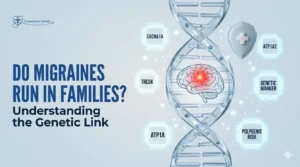
Familial Hemiplegic Migraine (FHM) is associated with mutations in specific genes:
These genes regulate ion transport in nerve cells. When altered, they disrupt neural communication, leading to severe migraine episodes that may include temporary paralysis or neurological deficits.
Another important genetic discovery involves the TRESK gene, which is linked to pain signaling in the trigeminal system. Although mutations are rare, they highlight the role of ion channel dysfunction in migraine development.
The Role of Environment and Triggers
Genetic predisposition alone does not cause migraine attacks. Environmental and lifestyle factors act as triggers that interact with a sensitive nervous system.
Common triggers include:
- Stress and emotional fluctuations
- Hormonal changes
- Sleep disruption or irregular routines
- Dietary factors and dehydration
- Sensory stimuli such as bright lights or strong odors
These triggers do not act independently. Instead, they lower the threshold required to initiate a migraine in an already sensitive brain.
This explains why individuals with similar genetic backgrounds can experience very different migraine patterns.
Can Genetic Migraines Be Managed?
Although genetic factors cannot be modified, their impact can be significantly reduced.
Effective management strategies focus on:
- Identifying and avoiding personal triggers
- Maintaining consistent sleep patterns
- Managing stress through structured techniques
- Staying hydrated and maintaining balanced nutrition
- Following medical treatment plans when necessary
Early recognition of patterns, particularly in individuals with a strong family history, improves long-term outcomes and reduces disease burden.
When to Seek Medical Evaluation
Medical consultation is recommended when migraines become frequent, severe, or disruptive. Additional warning signs include:
- Sudden changes in migraine pattern
- Neurological symptoms such as weakness or confusion
- Strong family history with worsening symptoms
Neurological evaluation helps identify underlying mechanisms and supports personalized treatment planning.
Final Thought
Migraines frequently run in families, reflecting a strong genetic component. However, they are not purely inherited conditions. Instead, they arise from a complex interaction between genetic predisposition and environmental triggers.
This perspective shifts the focus from inevitability to management. With proper understanding, early intervention, and targeted care, the impact of migraines can be significantly reduced.










 Optimized by Seraphinite Accelerator